
Generating high-quality images and videos with AI is no longer a rare skill. However, there is a massive gap between producing compelling work and presenting a unique perspective through a cohesive body of work.
The question today isn’t just whether you can master the tools. What matters is the vision you explore through generative AI, the world you build, and how you connect that work to cultural and contemporary contexts. Those who can shape that entire process are the ones we call “Generative AI Artists.”
A Generative AI Artist is not merely an operator outputting AI files; they are an artist shaping personal inquiries and ideas into a continuous body of work. They are evaluated by different standards from “AI Creators,” who typically focus on practical tasks and problem-solving. For an artist, the focus extends beyond the standalone piece to the underlying context, editorial judgment, transparency, and consistency across their practice.
This article clarifies the definition of a Generative AI Artist, outlining the differences from an AI Creator, the necessary “5 Pillars of Artistry,” monetization structures, copyright and ethical considerations, and a roadmap for progressing from a beginner to the global stage.
- A Generative AI Artist is a creative voice presenting unique inquiries and philosophies, not just an operator generating outputs with AI.
- The distinction from an AI Creator lies not just in the quality of the deliverables, but in authorship, consistency, contextual grounding, and underlying philosophy.
- Their scope of activity extends beyond independent production to exhibitions, brand collaborations, IP development, and educational or research partnerships.
Table of Contents
What is a Generative AI Artist?
Defining the Generative AI Artist
AI Creators defines a Generative AI Artist as an “artist who treats generative AI not merely as a tool, but as a medium—elevating it through their own sensibilities, editorial judgment, and technical choices to consistently present a unique worldview.”
What matters is treating AI as a medium, not just a tool. This requires the flexibility to embrace unpredictable deviations and the randomness of AI models as a core part of the creative process.
The Fundamental Difference from “Someone Using AI to Make Images”
With current tools, anyone can output beautiful images in seconds. However, technical proficiency alone does not guarantee artistic value or authorship.
The difference between “someone using AI to make images” and an “artist” lies in the continuity of the work and whether it wrestles with questions like “why this motif?” or “why this texture?”
It is not just about the perfection of a single image, but the underlying theme: what is being observed and why it is being presented to the world.
Why It Is Necessary to Distinguish These Terms Now
AI tools have become mainstream, enabling anyone to produce strong work. Consequently, the distinction of “who is making this, and why” has become more critical than ever.
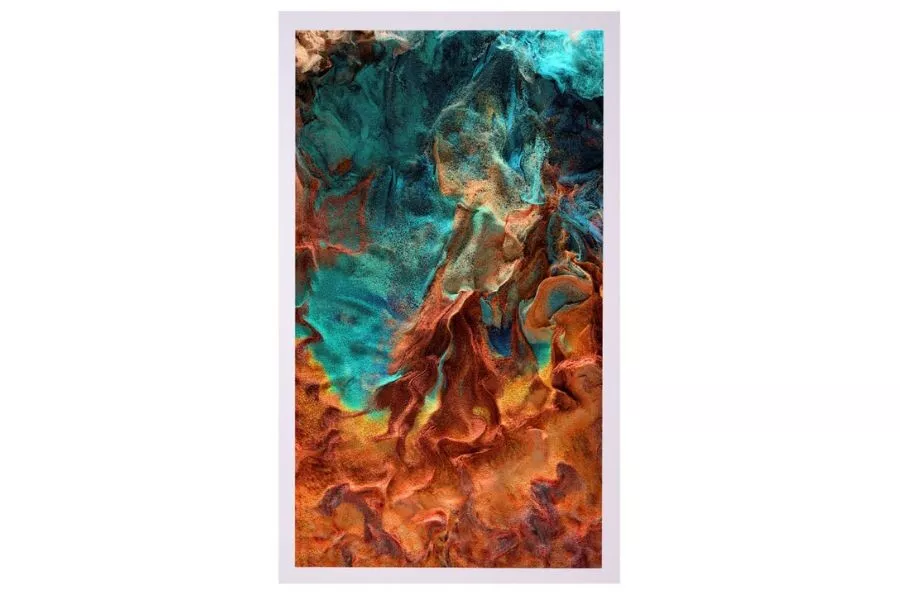
In March 2025, Christie’s held the first dedicated AI art sale by a major auction house, concluding with a total of $728,784.
(Source: Christie’s)
Such developments indicate that AI expression is increasingly treated within the context of contemporary art, rather than merely as technical demonstrations. Therefore, there is growing significance in distinguishing between the AI Creator as a practical professional and the Generative AI Artist as an author of a body of work.
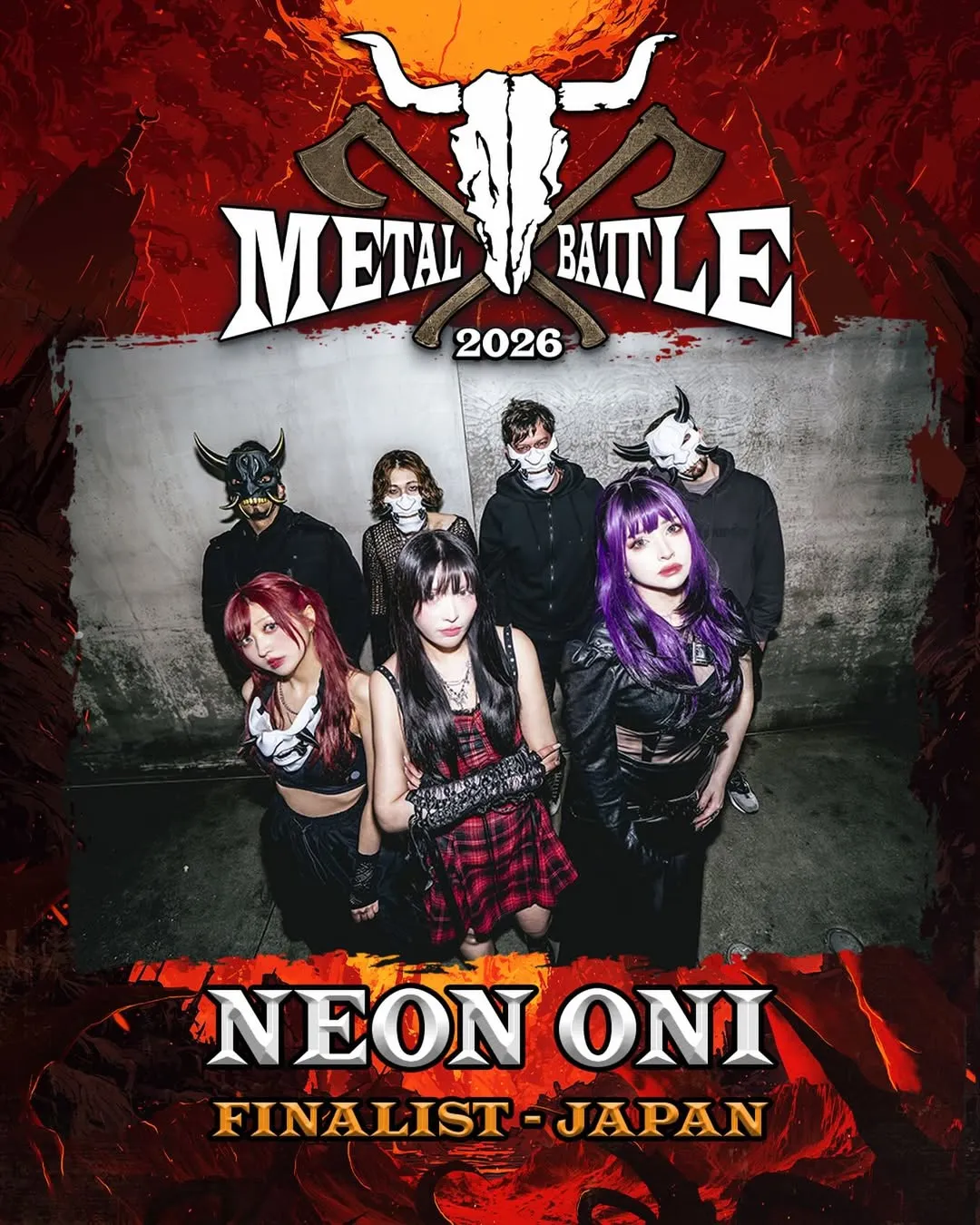
Additionally, we cannot overlook the narrative example of NEON ONI, an artist who transitioned from generative AI into a “real band.”
This digital IP, originating from Suno AI, achieved 80,000 monthly listeners on Spotify and advanced to the Japanese qualifiers for Wacken.
Differences Between AI Creators and AI Artists
There is no inherent superiority between the two. Because their objectives, evaluation criteria, and time horizons differ, it is important to clarify which direction (or both) you wish to pursue.
【Comparison: AI Creator vs. Generative AI Artist】
| Comparison Metric | AI Creator | AI Artist |
|---|---|---|
| Primary Objective | Problem-solving, commercial outcomes | Self-expression, cultural inquiry, aesthetic exploration |
| Starting Point | Requirements, client briefs, target audience | Philosophy, internal motivation |
| Source of Value | Implementation, reproducibility, speed | Authorship, context, scarcity |
| Core Evaluation | Quality, delivery time, business results | Concept, worldview, consistency |
| Primary Fields | Advertising, social media, corporate projects | Exhibitions, brand collaborations, IP, culture |
| Time Horizons | Project-based | An ongoing body of work |
| How Companies See Them | Production and implementation partner | Co-creator enhancing brand value |
Objective: Problem-Solving vs. Expression
AI Creators aim to solve client problems and generate commercial results. In contrast, Generative AI Artists operate primarily for self-expression, societal inquiry, and the exploration of aesthetics.
Starting Point: Requirements vs. Philosophy
AI Creators work backward from requirements definitions and target audience design. Generative AI Artists construct their work starting from internal motivations, philosophies, and aesthetics.
Evaluation: Deliverables vs. Context
The value of an AI Creator is measured by output quality, reproducibility, and production efficiency. A Generative AI Artist is evaluated on the strength of their concept, the consistency of their creative world, and the context they present.
Time Horizons: Project vs. Worldview
A creator’s work is segmented by project, whereas an artist’s activities are sustained over a long-term series or a lifelong creative practice.
How Companies See Them: Production Talent vs. Brand Co-Creator
For corporations, AI Creators are excellent production and technical partners. Generative AI Artists, however, are often positioned as co-creators who expand the brand’s core values.
The “5 Pillars of Artistry” for Generative AI Artists
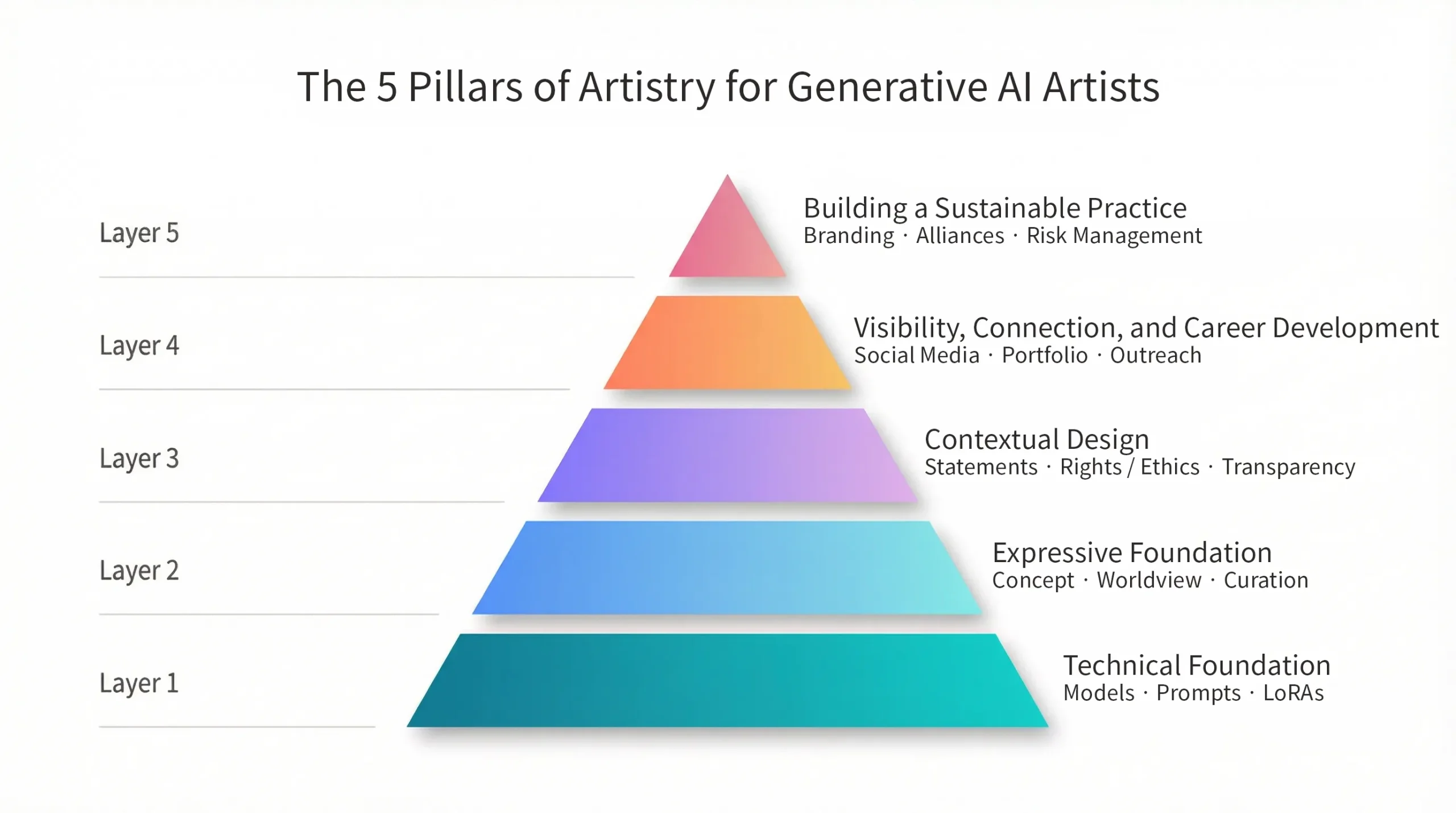
Layer 1: Technical Foundation
The first requirement is a technical foundation to operate generative AI. This demands an understanding of the characteristics of major generation models across images, video, and audio, and the ability to apply them strategically.
Specifically, this includes prompt design, workflow construction, and the training and fine-tuning of custom models or LoRAs.
Layer 2: Expressive Foundation
The expressive layer transforms technology into art. It is not enough to simply arrange generated outputs; the focus is on what to show and how to show it.
This requires conceptual design skills, a consistent worldview, an understanding of art history and visual grammar, and the editorial capability to select and curate generated results.
Layer 3: Contextual Design
The ability to design context connects the artwork to society. Beyond the visual impact of a single piece, an artist must consider the underlying issues it addresses and how it reaches others.
This involves the ability to write artist statements, articulate concepts for exhibitions and critique, and understand rights, ethics, and transparency.
Layer 4: Visibility, Connection, and Career Development
Creating art doesn’t automatically generate opportunities. Modern Generative AI Artists must be able to communicate their work in their own words, present it to the right audience, and connect it to exhibitions, collaborations, and commercial projects.
Visibility involves managing social media, building a portfolio, publishing statements, and introducing yourself (often in English). Connection means proactively reaching out to galleries, brands, and media.
Even the most striking work will struggle to find an audience if its background and themes remain unknown.
Layer 5: Building a Sustainable Practice
Once you achieve a certain level of recognition, you need the ability to design a sustainable practice. The focus shifts from temporary buzz to building a foundation that supports long-term expression and growth.
This includes forming alliances, branding, establishing a workspace or team, managing finances, and preparing for potential public backlash or copyright disputes.
As your scope grows, so do the decisions required outside the art itself. You don’t have to handle everything alone; collaborating with others becomes crucial.
AI Creators aims to support not just the connection between art and opportunity, but the long-term growth and sustainability of these artists.
Why Technology Alone Does Not Make an “Artist”
Technical proficiency alone cannot guarantee artistic value. Value lies not just in the output itself, but in the questions behind it and the editorial decisions that shape it.
What Does a Generative AI Artist Create?
Static Images, Fine Art, and Photographic Expression
High-fidelity image generation remains a vital foundation. However, these are increasingly presented not merely as illustrations, but as fine art or conceptual photography.
Video, Music Videos, Animation, and Short Films
With the advancement of video generation AI, time-based media production has expanded significantly. Attempts to reconstruct visual grammar itself—through music videos, short films, and animated expressions—are underway.
Music, Audiovisual, and Live Performance
In addition to music production using audio generation models, audiovisual expressions and live performances that synchronize video and sound are becoming critical domains.
Character IP and Worldbuilding
Consistently generating characters and fictional worlds allows for an approach focused on IP development. This area aligns closely with Japanese character and narrative culture.
Exhibitions, Installations, and Spatial Experiences
There is a growing movement to deploy generated outputs into physical spaces, evolving into immersive installations and spatial experiences. This involves complex expressions combining projections, spatial audio, and physical 3D outputs.
Integration with Fashion, Crafts, Architecture, and Products
Generative AI outputs are utilized as inspiration for pattern design and product development. Connecting AI with material domains like crafts, fashion, and architecture represents a major future opportunity.
A Roadmap for Generative AI Artists
Here, we outline the progression for beginners to deepen their practice as Generative AI Artists across five stages. While individual paths vary, this serves as a broad conceptual map.
Stage 1 (0–3 Months): Exploration and Immersion
Begin by focusing intensely on one or two tools. Through volume and repetition, observe what naturally draws your interest. The goal is to be able to articulate the “reason I create this” in a single sentence.
Stage 2 (3–9 Months): Style and Experimentation
Next, cultivate the sense of building an ongoing body of work rather than generating one-off pieces. Establish your creative axis by focusing on motifs, colors, and compositions. When necessary, experiment with custom models or LoRAs to learn the balance between reproducibility and variation.
Stage 3 (9 Months–2 Years): Publishing and Contextualization
At this stage, begin presenting your work publicly. Managing social media, building a portfolio, submitting to open calls and exhibitions, and drafting artist statements (often in English) become essential. You are now entering a phase where you must consider “how the work is read.”
Stage 4 (2–4 Years): Specialization and Crossover
Once a definitive style and theme emerge, expand into other domains. Explore where your expression connects—be it exhibitions, video, spatial design, corporate collaborations, education, or research. The key is not to be someone who “can do anything,” but to build a reputation where people say, “this person is the definitive voice in this specific area.”
Stage 5 (4 Years+): Definition and Legacy
Ultimately, you may progress to a position where you help define the field itself, rather than just publishing your own work. This stage involves shaping the wider ecosystem through critique, education, community building, and mentoring the next generation.
Technical Mastery is Not the Only Goal of the Roadmap
Tools will continue to evolve. What remains is what you observed and the body of work you accumulated. The essence of this roadmap lies in sustaining your core inquiries, rather than merely chasing the latest technical updates.
Complex Monetization Models for Generative AI Artists
The activities of a Generative AI Artist do not rely solely on direct artwork sales. It is vital to construct a multi-layered practice combining one-off revenue, recurring revenue, and trust building.
Artwork Sales (Physical, Digital, Editions)
Selling physical prints, digital works, or limited editions. This is a foundational revenue stream for building an artist’s reputation.
Commissioned Work (Advertising, Music Videos, Visual Production)
Producing key visuals, videos, and music videos upon request from corporations, brands, and other artists. These are sometimes structured as true collaborations rather than standard outsourcing.
Brand Collaborations and Corporate Tie-Ups
Connecting the artist’s style and themes with a brand’s worldview or campaign. This generates not only one-off compensation but also long-term visibility and credibility.
IP, Character, and Licensing Operations
Expanding self-developed characters and worldviews into intellectual property for licensing, publishing, and merchandise. This holds the potential for a sustainable recurring revenue base.
Education, Speaking, Workshops, and Grants
Alongside production, activities can include lectures, workshops, academic speaking engagements, and securing cultural grants. This builds both revenue and institutional credibility.
Why “Artists Can’t Earn” is an Outdated View
Modern Generative AI Artists are well-positioned to diversify their revenue streams by combining sales, commissions, IP, corporate collaborations, and education. The key is not to rely on a single method, but to construct a business model that naturally aligns with your creative expression.
Why Corporations and Brands Seek Generative AI Artists
Why a Standard AI Operator is Insufficient
When companies seek new brand experiences and new forms of expression, merely generating outputs according to instructions is often inadequate. What they require is a creative voice who possesses a unique perspective, clear themes, and the ability to design meaning.
How Vision-Driven Expression Elevates Brand Value
Collaborating with Generative AI Artists can signal a company’s forward-thinking and cultural awareness. It serves not just as advertising, but as an opportunity to update how the brand communicates its story.
Applications in Advertising, Video, Spatial Design, and IP Development
Generative AI Artists can contribute across a wide range of scenarios, including key visual production, brand videos, event space design, and character development. They are particularly effective when a brand requires a level of originality that is difficult to achieve through traditional production methods alone.
5 Points Companies Should Verify Before Commissioning
- Does the artwork’s worldview connect with the company’s brand?
- Is the transparency of the generation process ensured?
- Is there a clear stance on copyright and training data?
- Is the expression sustainable, rather than relying on temporary buzz?
- Can the artist manage practical communication and delivery schedules?
Current Landscape: Global vs. Japan
AI Art Markets, Exhibitions, and Criticism Abroad
Internationally, the movement to treat generative AI expression within the contexts of auctions, exhibitions, and media art is expanding. The discussion is advancing beyond market value to include institutional critique and the artwork’s theoretical grounding.
Expanding Creative Possibilities in Japan
Japan offers a highly compatible foundation for generative AI expression, driven by strong traditions in animation, character culture, video editing sensibilities, and deep narrative structures.
Japanese creative output naturally tends toward uniqueness in its handling of narratives, characters, textures, and semiotics.
Why Generative AI Expression from Japan Tends to Be Unique
Japanese creative output naturally tends toward uniqueness in its handling of narratives, characters, textures, and semiotics. This is not a matter of direct superiority over international markets, but rather an environment that inherently fosters differentiation.
Navigating Copyright and Ethics
Fundamental Issues of Copyright and Training Data
Copyright for generative AI works remains a subject of ongoing debate globally. Reports published in January 2025 by the United States Copyright Office (USCO) emphasize the importance of human creative contribution.
(Source: U.S. Copyright Office)
In Japan, the Agency for Cultural Affairs has also outlined key discussion points, focusing heavily on the presence of human creative intent and expression.
(Source: Agency for Cultural Affairs, Japan | Regarding AI and Copyright)
Issues of Imitation, Style, and Transparency
Excessively imitating the style of a specific artist should be approached with caution, not only from a legal standpoint but also considering authorship and ethics. The ability to explain the data and methodologies used in production is directly tied to an artist’s credibility.
How to Protect and Expand Your Authorship
Cultivating custom models, proprietary data, and unique production workflows helps protect your creative output. For instance, Adobe’s Firefly Custom Models provides an environment for eligible plans to consistently train and generate specific, proprietary styles.
These practices serve not merely as defensive measures, but as expansions of authorship.
Considerations for Corporate Projects
In corporate commissions, it is necessary to establish clear terms regarding copyright ownership, usage rights, modification parameters, and accountability for the generation process in advance.
Designing the contract is just as important as the production itself.
Authorship in the Era of AI Co-Creation
Moving forward, the focus will likely shift from whether AI was used, to the types of human judgments made and the location of the creative contribution. Authorship emerges not just from the content of the final piece, but from the accumulation of the production process and editorial decisions.
Future Prospects for Generative AI Artists
The Commoditization of “Operators” vs. The Rising Value of “Artists”
As generative AI tools continue to improve, standard outputs will become increasingly difficult to differentiate.
Conversely, artists with clear themes and a recognisable body of work are likely to be valued much more highly.
What Remains After the Tools Become Transparent
Eventually, the use of generative AI will no longer be considered special. When that time comes, what remains will be what the artist observed, what they selected, and the context in which the work was presented.
The Ideal Creator in the Era of AI Agents
In the future, the weight of editing, staging, and creative direction is expected to increase further. As AI takes on multiple stages of production, humans will be required to possess the judgment to decide “what must be established.”
Shared Traits of Next-Generation Cultural Leaders
Individuals who possess their own inquiries and can translate them into a sustained body of work—beyond mere adaptability to new tech—are the ones expected to lead the creative field moving forward.
Frequently Asked Questions (FAQ)
Q. Should I aim to be an AI Creator or a Generative AI Artist?
If resolving business challenges and building a practical career is your priority, aiming to be an AI Creator is the realistic path.
However, if you want to center your practice around your own themes and strong expressive impulses, the path of a Generative AI Artist may be more suitable. The two are closely related, and dual roles or transitions are highly plausible.
Q. Can I become one even if I cannot draw or program?
Yes, it is possible. However, skills such as verbalizing prompts, discerning generated results, and designing the conceptual framework of the artwork are absolutely essential.
Q. Where should I start?
Begin by selecting a tool that suits you and interacting with it daily. Simultaneously, observe pioneering examples globally and try to articulate in words why those specific expressions are successful.
Q. If my work is strong, how do I connect it to exhibitions and commercial jobs?
Beyond the quality of the artwork, you need a portfolio, clear statements, consistent visibility, and networking.
If it is difficult to manage everything alone, utilizing communities or platforms that help connect artists with exhibition and collaboration opportunities is highly effective. Peer reviews and industry conversations serve as crucial catalysts.
Q. Will the copyright of my artwork be recognized?
This cannot be answered universally.
Generally, works generated solely by AI without human input are often denied copyright. Conversely, workflows that demonstrate clear human creative contribution—such as underlying philosophy, prompt design, structuring, selection, retouching, use of proprietary data, and research—are much more likely to be treated as copyrighted works.
Ultimately, decisions vary based on national regulations and specific cases.
Refer to AI Governance – 3. Human-Centered Creative Principle for more details.
Q. What is required to work internationally?
The ability to articulate your work in English is essential. Submissions for international art festivals and contests are predominantly in English.
Beyond the visual impact of your art, a statement conveying your themes and intent serves as the common language connecting you with overseas galleries and collectors.
Conclusion
A Generative AI Artist is not simply someone using AI to make images.
They are creative voices offering unique inquiries and sensibilities to society through the new medium of AI.
As generative AI capabilities continue to improve, differences in the tools themselves will become imperceptible.
Ultimately, what remains is not which model was used, but what was observed, what was selected, and the context in which it was materialized.
Therefore, the path of a Generative AI Artist is not merely a race to keep up with the latest tech. It requires refining technical skills while simultaneously deepening personal inquiries, cultivating a worldview, and developing a language that connects with others.
Over time, this ongoing commitment is what turns someone from a skilled operator into a true artist.
Even as tools change, the expression itself remains. And the questions and intent residing within that expression will ultimately determine your value in the era to come.
Taking the Next Step
To sustain a creative practice, you need not only to refine your work but also to build pathways that deliver it to the right audience.
How you structure your environment for learning, publishing, and securing collaborations is an integral part of your artistic journey.


