
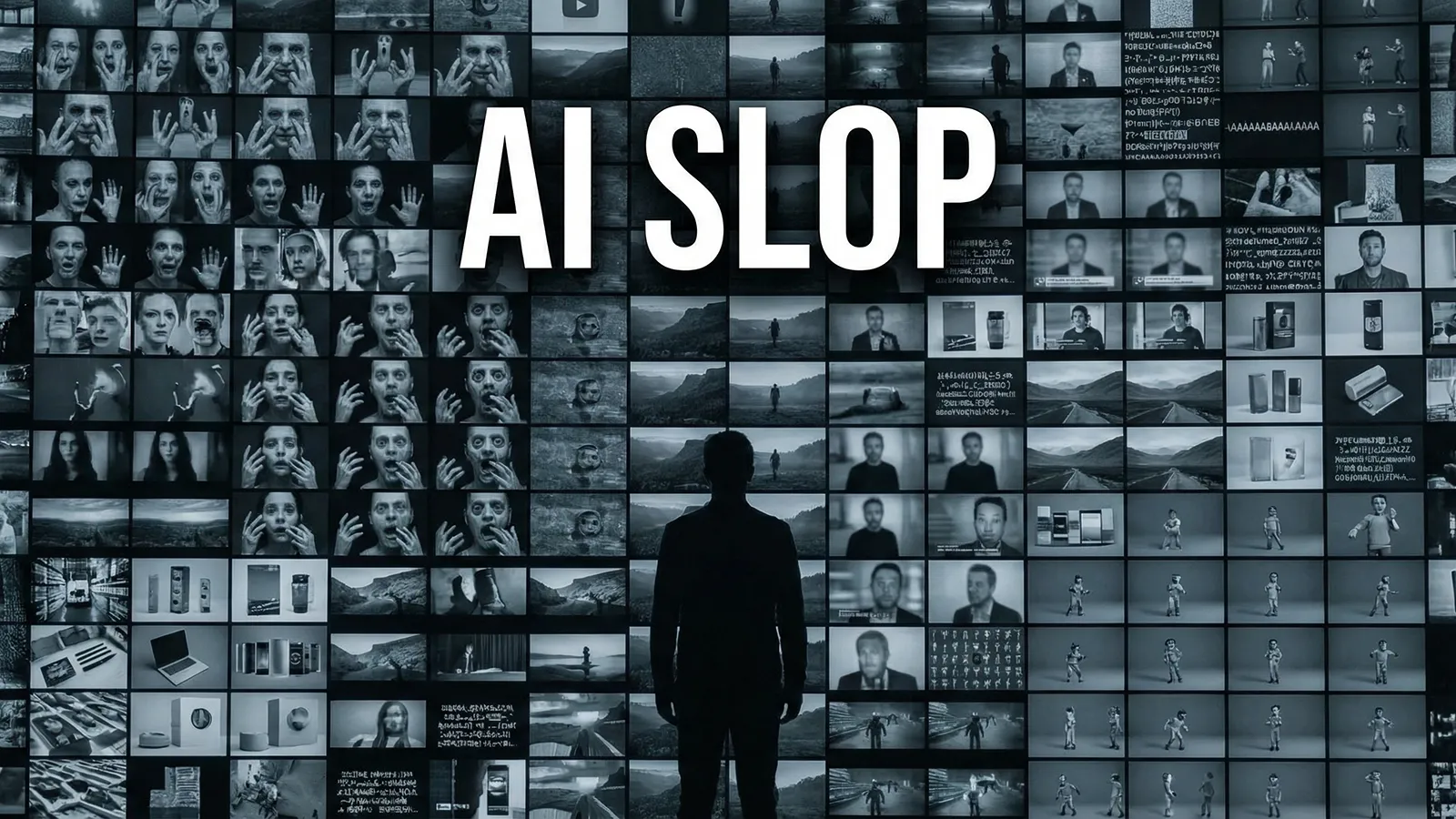
Generative AI has made it possible for almost anyone to produce convincing visuals, copy, and video in a fraction of the time it once took. The tools can give you something that looks finished. But those same tools have also flooded the market with output that reads, at a glance, as unmistakably AI-generated — generic in composition, flat in tone, and empty of context.
The question being asked now isn’t whether you’re using AI. It’s how deeply you’ve thought, designed, and refined what comes out of it.
The market has already moved past its first phase. What clients are increasingly asking for isn’t “no AI” — it’s “AI is fine, but it shouldn’t look like AI.”
Audiences are no longer impressed by the fact of generation. The bar has shifted: what matters now is whether the output can survive revision, hold up across formats, and serve the brand over time. That means the gap between strong and weak work is no longer about output volume. It’s about the quality of the design decisions and editorial judgment behind it.
This article uses the concept of “AI slop” as a lens to diagnose the problem — and then lays out a framework for the kind of creative direction that commands premium-rate client work.
Table of Contents
Chapter 1 | What Is AI Slop, and Why Does It Matter Now
“AI slop” is a term that emerged in English-speaking creator communities to describe high-volume, low-intention AI output — work that is generic, context-free, and interchangeable.
It isn’t a criticism of AI-assisted work in general. The problem isn’t the technology. It’s the uncritical, unedited output that gets passed off as finished work.
AI slop tends to share a recognizable set of traits. The compositions feel familiar. The copy is flat. There’s no sense of brand or context. The textures are either slightly off or so polished they feel sterile. It might look acceptable in the moment, but there’s nothing that stays with you. That’s the pattern.
Why is it a problem now, specifically? Because the volume has crossed a threshold. Novelty — “look what the tool can do” — no longer carries weight on its own. Work is now being evaluated on quality, intent, and meaning.
The economic consequence is structural. When everything looks like it could have been made by anyone, it creates a market-wide assumption that AI work should be cheap. That’s what drives rate compression.
From a client’s perspective, the damage runs deeper than aesthetics. AI slop is structurally difficult to work with: when revision requests come in, there’s no rationale to explain why the creative went in that direction. Brand tone shifts with each new execution. Consistency erodes over time. Internal sign-off becomes harder to secure. This kind of operational breakdown quietly undermines trust — and it compounds. The intention was to cut costs. The result is damage to brand equity. That’s the real risk of AI slop.
Chapter 2 | AI Slop Comes from Outsourcing Your Judgment, Not from the Tools
Blaming the tools for AI slop misses the point. The same models, the same platforms — the output quality varies dramatically depending on who’s using them and how. The problem isn’t on the tool side. It’s in the depth of thinking on the human side.
The issue is treating the first thing that comes out of a prompt as a finished deliverable. It isn’t. Generated output is raw material. Think of it like ingredients arriving at a kitchen. What happens next — what you keep, what you cut, how you shape it — that’s where the actual work begins.
“The AI is good at this” and “you are good at this” are not the same statement. AI returns probabilistic output in response to instructions. Giving that output intention, context, and quality assurance is a human responsibility. When that distinction gets blurred, real problems follow in production:
- The work arrives finished but purposeless — it’s unclear what it was supposed to communicate
- Quality is inconsistent and can’t be reliably reproduced
- Revision requests and intent questions can’t be answered with any real rationale
- Clients don’t feel confident commissioning follow-on work
Hands-off prompting can look efficient. But it produces work no one wants to stand behind — and over time, it’s a production style that doesn’t build trust. The distinction isn’t just about output quality. It’s about who takes responsibility for what the work says and does. Shifting away from that hands-off posture is the starting point for attracting higher-value client work.
Chapter 3 | What Creative Direction Actually Means for Premium-Rate Work
So what separates directed work from AI slop? The core isn’t about polishing output. It’s about designing the intent and context before and during the process — that’s creative direction. Here are six principles that define it.
3-1. Design the Intent
Before production begins, articulate who the work is for, what it should communicate, and what it should make them feel.
A campaign built to grow awareness and a campaign built to drive direct purchase have entirely different definitions of “right” — and entirely different creative answers, even when the visual quality looks equivalent. Even when clients haven’t clearly articulated those goals themselves, helping them define the brief is part of the director’s value.
3-2. Treat Generated Output as Material, Not Result
Not accepting the first output as the final output is the foundation of quality.
Rather than publishing the first image that comes out, the practice is to generate multiple options, compare them, and make deliberate decisions about what to cut. What distinguishes strong work isn’t the volume generated — it’s the precision of the selection and editing process. The craft lives in what you choose not to use.
3-3. Maintain a Consistent Brand World
Color, tone, composition, emotional register, sense of light, warmth of language — keeping these aligned is what makes a body of work feel coherent.
When the tone shifts between a banner, a social post, and a landing page, brand credibility takes a visible hit — and that inconsistency becomes expensive to correct late in production.
A single striking execution matters less than a body of work that reads as one continuous experience — that’s what builds brand equity. Visual and tonal consistency is also, practically, one of the most effective ways to prevent work from reading as AI-generated.
3-4. Catch Incongruities and Fix Them
In images, it might be the hands or the eyeline. In copy, it might be a tonal inconsistency or an off-register word — something that reads fine in isolation but breaks the voice of the piece. These small things have an outsized effect on how the whole piece lands.
People respond to these details even when they can’t explain why something feels wrong. Not ignoring “something’s off” is what determines final quality. Having that sensitivity — and acting on it — is something tools can’t replicate.
3-5. Inject Context
Brand tone, industry context, audience state of mind — these need to be embedded in the work, not assumed.
The same idea of “warmth” looks completely different in a luxury brand context versus a public sector communication. The final step is overwriting the generic with something specific — giving the work a voice that belongs to someone. That’s how you move past output that looks competent but belongs to no one.
3-6. Build for Quality Control and Reproducibility
A single strong execution matters less, in practice, than being able to produce at the same standard the next time.
The work needs to hold up under revision, across formats, and throughout an ongoing relationship.
At the higher end of client work, what’s being evaluated isn’t just the final deliverable — it’s whether the production system behind it can be trusted. “I know this person will deliver the same standard again” is what generates repeat commissions.
Chapter 4 | What the Difference Looks Like in Practice
The same brief, handled two different ways, produces work that feels fundamentally different.
Take a concrete example: social media content for a sustainable apparel brand, targeting urban consumers in their late twenties to early thirties.
- Generic bright-natural-light product imagery used as-is
- Copy along the lines of “Make the eco-friendly choice”
- A string of hashtags with no editorial logic
- No clear sense of who it’s for
- No identifiable brand personality
- Nothing that stays with you the next day
- Color temperature and texture aligned to the brand’s visual identity
- Copy that speaks in the audience’s own register
- Deliberate selection — what’s included and what’s left out
- The full post reads as a single, coherent experience
- Details that give you something to look at twice
- Designed to hold up under revision and across formats
The undirected output is missing two things: a judgment about audience, and a deliberate decision about what to keep.
The directed output goes further — it’s designed not just for how it looks, but for how it will be read. That difference determines how the finished work is received.
But the value difference isn’t only visible in the initial output. It shows up when the client asks for a revision, when the campaign needs to extend to a new format, or when the same brief has to be executed six months later. Directed work is built to survive those conditions. Undirected work rarely is. When the revision conversation comes, or the brief for the next execution, and the response inspires confidence — that’s what compounds into higher-value work.
Chapter 5 | Why Creative Direction Is What Commands Premium Rates
“I can use AI” is no longer a differentiator. Using it is assumed. What’s being evaluated is what you do with it.
Premium rates aren’t paid for visual impact. They’re paid for the confidence of handing over a decision. More specifically, they’re paid for the confidence that someone can make and defend creative decisions under real production conditions — through briefs that shift, revisions that multiply, and stakeholders who need things explained.
Clients are paying not just for the final deliverable, but for the soundness of the design rationale, the ease of revision, and the ability to explain creative choices clearly.
Someone who can be trusted across the full scope — from intent design to quality control — is genuinely hard to replace. Being commissioned by name, specifically, comes from having a point of view, a set of standards, and a design process — not just from making attractive work.
From a client’s perspective, there are four conditions that make it feel safe to commit real budget to a creative partner:
- Reproducibility — consistent quality across executions
- Accountability — the ability to explain why the creative went where it did
- Brand alignment — genuine understanding and control of the brand’s visual and tonal identity
- Operational confidence — reliable handling of revisions, pivots, and format extensions
Premium rates aren’t simply a pricing question. They’re the return on trust.
And that trust is built not through generation speed, but through the depth of judgment, design, and editing.
Chapter 6 | The Skill That Matters Now Is Editorial Judgment, Not Generation Speed
Generative AI has dramatically lowered the barrier to making things. Creative work that once required specialized skill can now be produced in rough form by almost anyone, in a short time. That’s a genuine and significant shift.
But as a consequence, value has migrated — away from output volume, toward the ability to shape output into something meaningful.
If anyone can produce a version of something, the act of producing it stops being rare. What remains rare is the capacity to give that output intention, context, and coherence — to catch what’s wrong with it, to be accountable for what it says.
Conceiving, selecting, unifying, correcting, explaining, finishing — taken together, that’s what creative direction is. It’s not a position against AI. It’s the editorial and decision-making work that makes AI output worth something.
What we consider valuable isn’t the ability to generate — it’s the ability to shape output into something that means something.
The priority isn’t using AI fast. It’s making considered, accountable creative decisions. Not whether to use AI, but how to design and refine what it produces. That’s the position AI Creators is built on.
Chapter 7 | How to Position Yourself to Attract Higher-Value Work
Given all of this, how do you make the value visible? Leading with “I can use AI” isn’t enough. You need to position yourself as someone who can direct AI toward a specific purpose.
In portfolios and proposals, the finished work is only part of what matters. Three things are worth showing:
- The final work — the quality of the output itself
- Creative intent — why this direction, for whom, communicating what
- The revision and refinement process — before/after, and a record of the decisions made in between
Showing all three moves a portfolio from a collection of work to a demonstration of practice.
The impression shifts from “this person can make things” to “this person can be trusted with a brief.” A portfolio built this way isn’t just proof of output — it’s proof of judgment. And judgment, in a market flooded with generated work, is the thing that actually differentiates.
What matters for your professional brand isn’t the number of pieces — it’s the consistency of your point of view. Having clear standards for what you consider strong work and what you’ll push back on, and communicating that through your writing and your output — that’s how you build a reputation as a director-level creative, not just a producer.
Conclusion | Sinking into AI Slop, or Designing for Value
The problem with AI slop isn’t AI. It’s the habit of generating without judgment and releasing without editing. Now that the technology is everywhere, the distinction will be between people who generate a lot and people who make deliberate, considered decisions about what they produce.
High-value client work follows from creative direction, not generation speed.
Designing the intent, selecting the material, maintaining the brand world, catching what’s wrong, injecting context, managing quality — this full chain of design thinking is what accumulates as trust and returns as value.
Three things worth starting today:
- Get into the habit of writing a brief intent document before production starts
- Treat generated output as raw material, not a finished deliverable
- Add your decision-making process to your portfolio
The market is no longer rewarding generation alone. It is rewarding judgment, coherence, and the willingness to be accountable for what you make.
What becomes valuable from here is the ability to take what gets generated and make it mean something — to stand behind it as professional, accountable creative work.
Is your AI practice ending at generation — or are you designing all the way through to value?
