
Table of Contents
1. Profile: Who is Karri Saarinen?
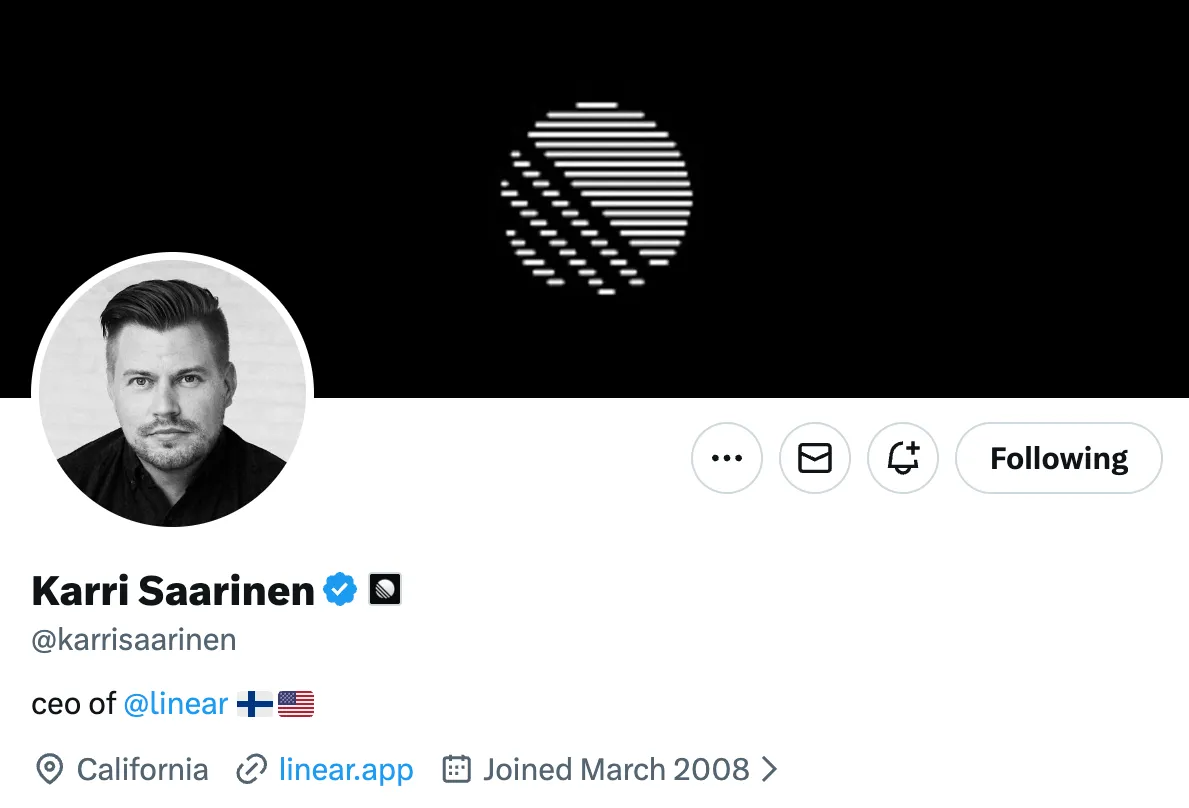
His career trajectory is notable. At Airbnb, he worked as a Principal Designer, contributing to large-scale design systems. He later served as Head of Design at Coinbase, where he faced the challenges of scaling design within a rapidly growing organization.
In 2019, he co-founded Linear. Since then, the company has grown quickly as a refined issue tracking tool for modern development teams. Linear is particularly recognized for its strong opinions on product design, performance, and user experience. Saarinen stands out not only as a practitioner of product design but also as a thoughtful voice on design philosophy.
2. [Full] Design is Search (December 13, 2025)
Part 1: Design is search
Coding tools are fine, useful, and they definitely help you make the design a reality. A lot of the commentary I’ve seen is about making design quality happen through better implementation, which is great but not really about designing.
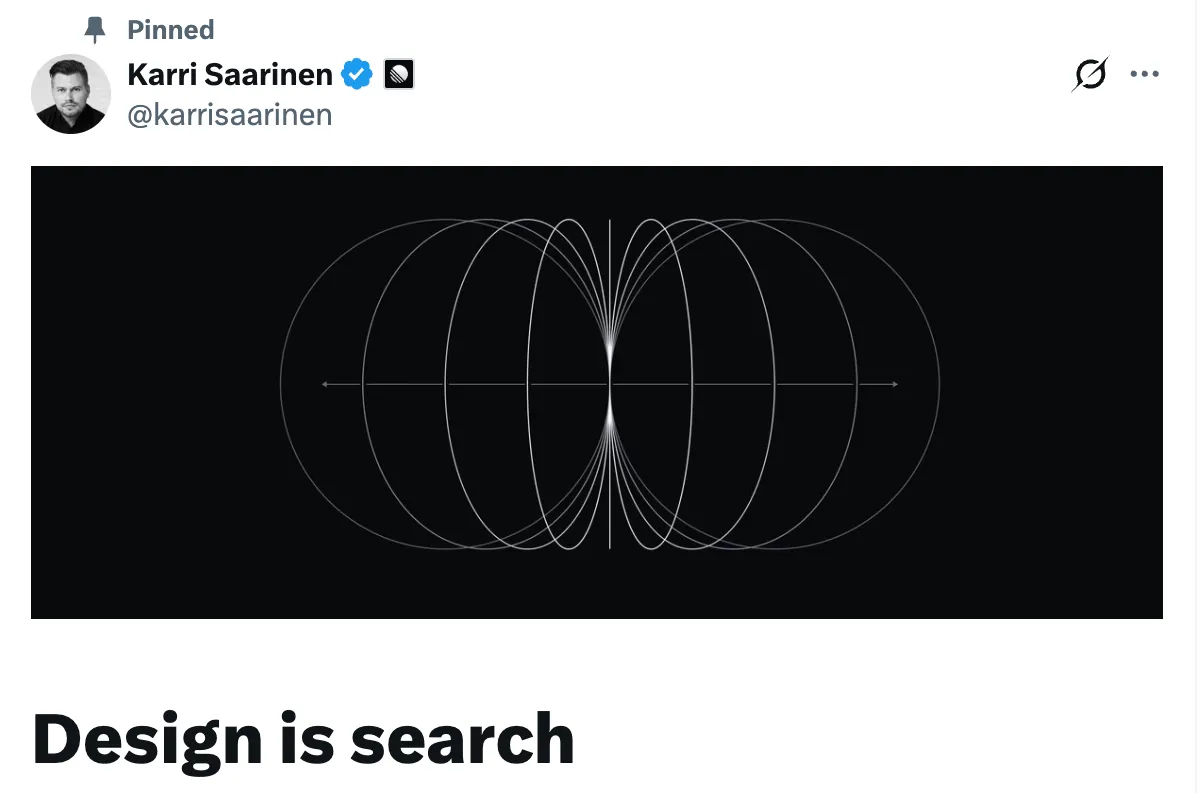
I tend to think about design as a search, not a production pipeline. You start with a messy problem. Early on, you do not know the answer. This is why I never fully buy the idea that design is about output. I agree that design is useless without shipping, but the process of designing is not.
The design process, and the suffering part of that process, are valuable.
Constraints
Constraints are not the enemy, but they can arrive early. Constraints exist in reality: time, budgets, codebases, teams, customers. The mistake is letting those constraints define the space before you have found a direction worth committing to. Then they start shaping your imagination. Early design is about direction. You are trying to find a form that resolves the problem in a way that feels obvious once you see it. That phase benefits from speed, looseness, and tools that let you change your mind without paying a tax for it. Later, constraints become essential. You want reality to push back. You want the medium to answer your questions. That is where prototyping, code, edge cases, performance, and all the sharp corners start improving the work. That is where the craft shows up, and where design-code tools can be useful.
Architecture
Architecture is full of constraints, more constraints than software will ever have: materials, gravity, weather, budgets, labor, code, zoning, politics. Yet it still often starts with sketches. Not because sketching is pure or nostalgic, but because it is a way to separate form from construction long enough to find something worth constructing. A sketch is not a smaller version of the final building. It is a different mode of thinking. It gives you permission to be wrong in interesting ways, and to paint broad strokes. You don’t design houses by iterating from one corner to a full house piece by piece.
I talked to a talented architect who was designing the most modern and sculptural house in a town known for traditional cabins. The ordinance demanded the local style. Starting from the ordinance would have produced something predictable and safe. Instead, the architect started from an idea that respected the landscape, involved the neighbors, built support, and when the plan reached the council, the community backed it. The rule bent. The architecture fit the landscape and the community, even if it didn’t technically fit the ordinance.
If you let constraints define the space too early, you do not just get a worse outcome. You lose outcomes that never get discovered.
Tools
Tools have opinions. They make certain actions easy and others annoying. Over time, they teach you what is “reasonable” to attempt. Some tools are great for exploration. They help you stay expressive and uncommitted. Others are great for construction. They reward structure, consistency, and correctness. Both are useful. The mistake is collapsing the entire act of design into a medium that is optimized for commitment.
I do not think designers should avoid code. Software is the material. Being ignorant of it leads to fantasy. But there is a difference between understanding the medium and letting the medium control you.
Code is a medium of commitment. Designing inside an existing system means inheriting its past decisions. You gravitate toward what is already supported. You make smaller bets because the cost of a big swing becomes obvious immediately. The result is often work that is elegant inside the current system, but less likely to change the system.
Unification
I understand the desire to unify tools and workflows. Handoffs are lossy. Quality decays in the seams between notes, designs, prototypes, roadmaps, and code. The dream of a coherent universe is compelling. A world where ideas move from chaos to clarity without translation loss. Where designers can build and builders can design.
I see the desire, and it can be good. But unification has a shadow side. It can turn into standardization. If everything is built from the same primitives, you get the same patterns repeated across teams. Tools raise the floor, but they can also lower the ceiling if they quietly define what is worth attempting. If the easiest path is always the most conventional path, convention becomes the product.
Our industry is somehow overly allergic to fragmentation. I’m not sure what it is really about. I actually think it’s a very human thing to have some level of fragmentation: different tools, spaces, environments for different purposes or mindsets.
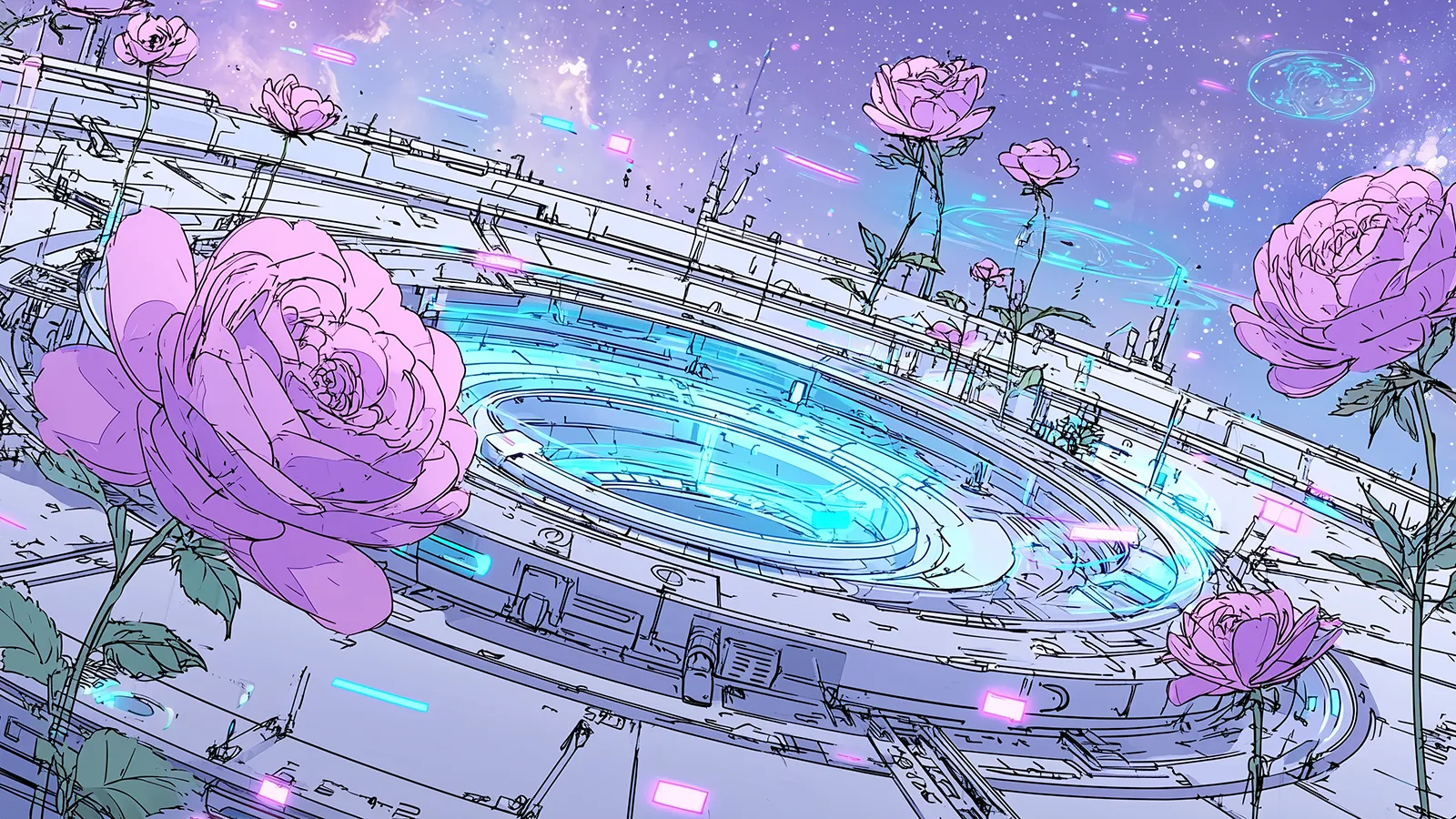
I might be proven wrong, but I don’t believe in great unification, and I think often it might be driven by a need to dominate industries, instead of letting many flowers bloom and letting each flower be very good in its own way.
What I actually believe
I am not interested in preserving a romantic separation between “design” and “engineering.” Some designers should code at times. Some engineers have great taste and should design. Some projects thrive when one person can take an idea all the way through.
The thing I want to preserve is a phase of thinking, and not pretend it is not worth our time. Early design needs freedom. Later design needs reality. When those phases get collapsed, you can still ship, often faster than ever. But you might also trade the search for the shortest path.
So my belief is simple. Use whatever tools you want, but be deliberate about what mode you are in. Protect exploration from premature constraint. Invite constraints when you are ready to learn from them. Use code as feedback, not as a cage.
New technology makes it faster to build, but that’s not really what design is about.
3. [Full] Design is a Search for the Opinions (December 15, 2025)
Part 2: Design is a search for the opinions
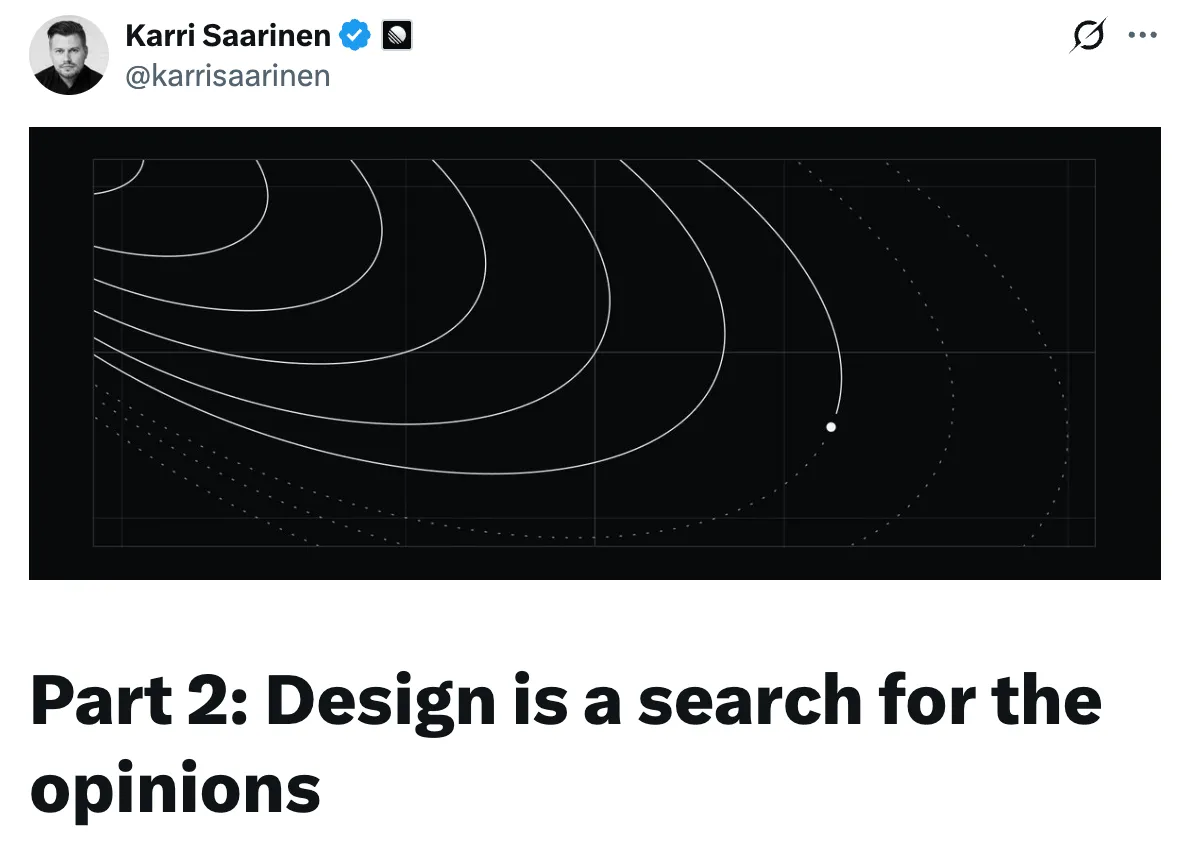
The level of opinion you introduce has tradeoffs. A very flexible system gives you many choices, but less guidance. An opinionated system gives you guidance, but fewer choices. People and businesses often buy opinionated systems for the same reason majority of the world buys cars, iPhones, or sandwiches. Someone already made a thousand decisions. You get the benefits quickly and move on to what matters, the work, the goal, getting from A to B.
The economy would grind to a halt if everyone rebuilt everything from scratch, from sandwiches to software. Civilization runs on shared decisions and reused solutions.
The “make your own things” from generic blocks idea is warm one, and I do appreciate it. Where it starts to lose me is when it tries to force a reality that doesn’t really exist, and it’s not what people do or look for.
Look at any craft. The kitchen. The workshop. Purpose-built spaces filled with purpose-built tools, often shaped by centuries of tradition (also sometimes known as experience).
Serious craftspeople don’t operate in primitives. A chef doesn’t stock “a knife”, “a pot”, “a carrot”. They have a specific knife, a specific size, a tradition they trust. A sushi chef doesn’t buy a generic knife from IKEA. A hobbyist might, because they don’t know better and they don’t do it every day. A cabinetmaker doesn’t buy “a saw.” They buy the best milling machine they can afford. As someone goes deeper into a craft, their needs get more specific, not more generic.
The metaphor of single use tools, like apps being avocado slicer goes only goes so far. If you’re slicing avocado all day, then you might really want to invest in a good avocado slicer while most people mind find it useless or excessive. And while it’s true that some apps are useful for one singular thing, like a fart app, doing one singular thing is not necessarily bad. A tool that does one thing extremely well can be valuable, even admirable. It’s not a monstrosity.
What to me is a monstrosity is the all-encompassing systems that don’t do almost anything particularly well. Trying to reduce life into atomic blocks, taking over everything. Like the Star Trek’s Borg. They assimilate the world into generic concepts to prove some unified grand theory.
Push that worldview into physical space and you get generic houses, white cubes. Then you hand people foam blocks and Minecraft-style primitives and tell them to construct their dwellings and tools. For some that could be very appealing, but I think many would fine it quite tiresome or not that inspiring.
Put that next to the world people actually love living in. Buildings shaped by tradition. Furniture shaped by designers. Art shaped by artists. Tools shaped by makers. Each object carrying a specific purpose and a story. That fabric is part of what life is and what makes it interesting.
Software isn’t exempt from this. Everything has conventions, all the way down. Programming languages have opinions. Frameworks have opinions. Even machine code comes with rules. There’s no true opinionless layer. Every system operates with some rules, in other words, opinions.
So the work is choosing which opinions to embed, and where. The search is for the design that feel human and help people get somewhere meaningful without trying dissolve the world into a bland table of primitives.
Instead of one grand theory or unification, I prefer a world of passion projects. Unique contributions. Ideas layered over centuries.
Not a bland, atomic table of primitives for me to play with.
4. Commentary: The Meaning of Design as “Search”

4-1. Design is Not a Production Line
Among Saarinen’s arguments, one of the most striking ideas is that “design is search, not a production pipeline.” This perspective is becoming increasingly important as design tools grow more sophisticated and AI spreads rapidly across creative workflows.
In today’s design industry, efficiency and automation are heavily emphasized.
Automatic conversion from Figma to React components, AI-generated layouts, and one-click prototypes that closely resemble final implementation have undeniably increased productivity.
However, Saarinen warns that these tools can compress the very “space for exploration” that design fundamentally requires.
In the early stages of design, answers rarely exist.
Often, even the problem itself is unclear. Design is the process of gradually finding form within chaos. The trial and error involved is not inefficiency—it is the essence of design and a core source of its value.
4-2. The Timing of Constraints Determines Everything
Constraints are not the enemy of design. What matters, Saarinen argues, is *when* constraints are introduced.
The architectural example he shares is particularly illustrative.
In a region governed by strict traditional design codes, an architect planning a modern, sculptural residence did not begin with regulations. Instead, they first read the landscape, understood the land, engaged in dialogue with local residents, and carefully built support for their vision.
As a result, when the proposal was submitted for review, the community backed it. Regulations became something to be interpreted flexibly, rather than rigidly enforced.
Had the architect started from the ordinance, the result would likely have been safe, predictable, and forgettable architecture.
Constraints introduced too early narrow imagination and eliminate solutions before they can even be discovered.
This principle extends far beyond architecture.
It applies to companies, product development, research, and all creative endeavors.
“The technology isn’t ready.”
“The budget doesn’t allow it.”
“We tried that before.”
When such statements dominate early discussion, thinking retreats into safety. The space where bold hypotheses should emerge turns into a competition for minor optimizations within existing frameworks.
4-3. Tools Have Opinions
Saarinen’s assertion that “tools have opinions” is a foundational insight—not just for designers, but for anyone engaged in creative or intellectual work.
Tools are never neutral.
They make certain actions easy and others difficult, and over time they shape our sense of what is “reasonable” or “realistic.”
Some tools are built for exploration, others for execution.
The danger lies in forcing the entire design process—especially its earliest stages—into a medium optimized for commitment.
Code is a classic “medium of commitment.”
Designing within an existing system means inheriting past decisions as assumptions. Available options are predefined, and ambitious ideas are immediately framed in terms of cost and risk.
The result is work that is polished within the current system but lacks the power to transform the system itself.
4-4. The Temptation of Unification and the Value of Diversity
Many industries dream of unification. Integrated tools, seamless pipelines, and a world where ideas flow into implementation without friction are undeniably attractive.
Yet Saarinen highlights the risks on the other side.
Unification often becomes standardization. When everything is built from the same primitives, the same patterns of thought are endlessly reproduced.
Tools can raise the minimum quality bar, but they can also quietly lower the ceiling of possibility by defining what is “worth attempting.”
He also challenges the industry’s excessive fear of fragmentation.
Using different tools for different purposes—and for different modes of thinking—is a deeply human practice.
What Saarinen rejects is “grand unification,” which is often driven not by a desire to nurture diversity, but by a desire for control.
4-5. Craftsmen’s Tools and the Trap of Primitives
In his second post, Saarinen deepens the idea of “searching for opinions.”
Every tool and device carries opinions.
They guide users toward certain behaviors and away from others. This, he argues, is both the responsibility of design and its greatest contribution.
He draws parallels with craftsmanship around the world.
Sushi chefs do not choose generic knives. Furniture makers do not buy “a saw”—they invest in specialized tools suited to specific tasks. As skill deepens, tools become more specialized, not more general.
Single-purpose tools are often misunderstood.
Tools that excel at one thing are not wasteful—they are worthy of respect.
What Saarinen criticizes is the all-encompassing system that aims to do everything yet excels at nothing—a philosophy that reduces the world to primitives and seeks to homogenize complexity.
4-6. Universal Insights Seen Through Culture and Context
Saarinen’s arguments transcend specific countries or cultures. They resonate deeply with traditional crafts, architecture, and design cultures worldwide.
European stone masonry, Asian woodworking, Middle Eastern decorative arts, South American handicrafts—each culture has developed “opinionated tools” and “opinionated forms” refined over centuries.
By contrast, modern global organizations often prioritize standardization in the name of efficiency.
Shared frameworks, shared processes, shared design systems are rational choices—but applying them too early in creative work risks cutting off possibilities before they emerge.
Across cultures, a common pattern appears: learning freely, questioning established forms, and eventually forging one’s own path. Saarinen’s vision of design—beginning with exploration and refined through reality—captures this universal creative rhythm.
5. My Perspective as an AI Creator: How to Protect the Future of Creativity
5-1. The Fundamental Question AI Tools Pose
As someone who creates with AI, Saarinen’s words feel like a particularly urgent warning for us “AI creators.”
AI tools are the ultimate opinionated tools.
Training data, algorithms, and prompt structures define what is considered “good.” More importantly, AI teaches those opinions to us with remarkable efficiency.
When we ask AI for “good design,” what we often receive is an averaged form of goodness—safe, polished, and broadly acceptable. Truly transformative ideas—those persuasive enough to bend rules, like the architect’s example Saarinen shared—rarely emerge from averages.
5-2. To Protect the Value of “Search”
I constantly ask myself: am I using AI as a “tool for search,” or merely as a shortcut to the fastest answer?
Requesting a first idea from AI is easy. But is that truly exploration?
Originality is born from wrestling with uncertainty—revisiting ideas, failing, and finally arriving at a moment that feels undeniably right.
In my practice, I treat AI as a dialogue partner.
I let it generate an initial draft, then I interrogate it. I deconstruct its suggestions, rebuild them, and sometimes discard them entirely. I do not follow AI’s opinions—I argue with them.
5-3. Crisis Awareness About Creativity Becoming Primitives
Saarinen’s “Borg” metaphor is already becoming reality in AI-driven creativity.
Prompt templates, best practices, optimized workflows—everything moves toward efficiency. The outcome is content with similar structures, similar aesthetics, and similar emotional tones.
My greatest fear is that “AI-generated content” becomes perceived not as a meaningful genre, but as cheap, rapidly produced imitation.
Like sushi chefs who refine their knives over decades, or furniture makers who deeply understand wood, AI creators must develop our own form of craftsmanship.
That craftsmanship is not just technical proficiency—it is the ability to judge, reinterpret, and challenge what AI produces.
5-4. AI as Constraint, AI as Freedom
AI can function as both constraint and freedom.
Many view AI as a tool that removes limitations. You can build software without coding, visuals without formal design training. This is true—but it may simply conceal constraints rather than eliminate them.
AI outputs are always generated within learned systems: design patterns, coding conventions, stylistic norms. Accepting them uncritically means designing inside those systems.
To use AI as a tool for freedom, we must question it.
“Why did AI choose this?”
“What alternatives exist?”
“Do I actually want this outcome?”
Only through such questioning does AI become a genuine instrument of search.
5-5. The Richness of Creativity Born from Diversity
Saarinen emphasizes the importance of “letting many flowers bloom.” This principle applies directly to AI creativity.
Imagine a world where everyone uses the same AI tools, the same prompts, the same workflows. The result would be a deeply homogenized creative landscape.
We each have a responsibility to cultivate our own flowers. Some may explore poetic expression with AI. Others may push data visualization or turn human–AI dialogue itself into art.
The goal is not to converge on a single “correct” way to use AI, but to experiment, fail, discover, and share. Diversity is what enriches the field.
5-6. Our Work is “Searching for Opinions”
The phrase “Design is a search for opinions” carries special weight for AI creators.
AI may appear to be opinion-less—it responds to any request. In reality, it is an aggregation of vast collective opinions, learned from countless designs, texts, and codebases.
Our task is to confront that collective intelligence with our own viewpoints.
“Is this necessary?”
“Who is this for?”
“What does this add to the world?”
Not blindly accepting AI’s “optimal” answers, but insisting on our own perspective—even when it is inefficient or misunderstood—is where our value lies.
5-7. Conclusion: A Future of Exploring with AI
Through Saarinen’s words, I have reaffirmed my position as an AI creator.
AI is powerful, but tools remain tools. Creativity lives in human courage—the willingness to face uncertainty, embrace struggle, and pursue what has not yet been seen.
We should use AI not as a shortcut, but as a companion in search.
Respect its opinions, but ultimately form our own. Resist homogenization. Let our individual flowers bloom.
Technology allows us to build faster. But as Saarinen reminds us, speed is not the essence of creation.
Creation is search. And now, AI has joined that journey as a new companion.
Our responsibility is to keep searching—through dialogue with this companion—for something only humans can discover, and only humans can create.
Isn’t that what it truly means to be a creator in the AI era?

