Disclosure: The author attended CapCut World 2026 Singapore as an invited AI creator and also took part in the CapCut AI Creators Hackathon. Travel and accommodation were provided by CapCut. This report was independently structured and written by the AI Creators editorial team.
CapCut’s first global community event series opened in Singapore in September 2026, and it did not look much like a conventional software launch.
There was a keynote, and there were new tools. But the event extended well beyond product announcements: a free public experience at Marina Bay Sands, an invitation-only program at Capella Singapore, AI Festival screenings, creator sessions, a red carpet, an awards gala, an after-party, and a hackathon in which teams of creators were given roughly 50 minutes to turn an idea into a finished film.
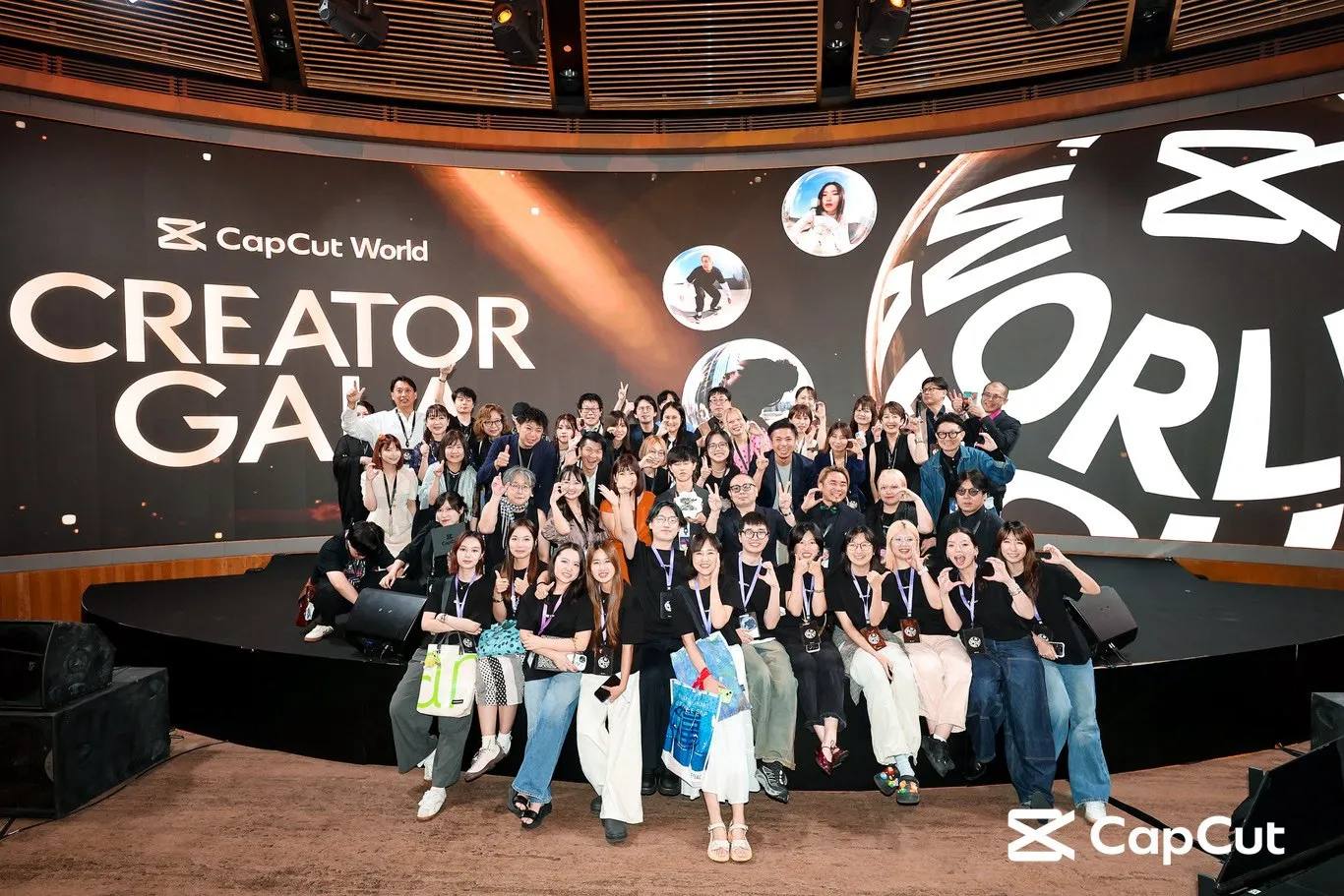
According to CapCut, more than 300 creators, industry professionals, and CapCut team members gathered in Singapore.
(Sources: Celebrating Our Community’s Growth at CapCut World in Singapore | CapCut Newsroom / CapCut World 2026)
Reading the event simply as “a big global CapCut gathering” misses what was actually on display. Three developments mattered more than any single feature announcement.
First, Skills — a mechanism for saving and sharing not only finished work, but the styles, workflows, and techniques behind it. Second, a creative pipeline extending from AI Lab through Infinite Canvas, generation, editing, and Edit Pilot, presented as a more continuous workflow rather than a collection of disconnected tools. Third, three distinct systems of recognition operating within the same event: Creator Awards, the CRE[AI]TE AI Festival, and the on-site hackathon.
What Singapore showed was not simply a video editor adding AI features. It was an attempt to connect creative output, production process, execution environment, community, and recognition into a broader creator economy.
| Item | Details |
|---|---|
| Event | CapCut World 2026 — CapCut’s first global community event series |
| Location | Singapore — first stop in the series |
| Public program | Marina Bay Sands / September 4–6, 2026 / free entry AI Studio, Design Studio, Edit Studio |
| Invitation-only main program | Capella Singapore / September 5, 2026 |
| Key programs | Keynote, Breakout Sessions, CapCut AI Festival screenings, Creator Workshop, Creator Awards, After Party |
| Attendance | 300+ creators, industry professionals, and CapCut team members combined |
| Organizer | CapCut (ByteDance) |
| Next stops | Los Angeles (October 2026) / London (November 2026) |
*The “300+” figure includes creators, industry professionals, and CapCut team members combined; it does not refer to creators alone.
(Sources: CapCut Newsroom / CapCut World Official Site)
Table of Contents
What Was CapCut World 2026 Singapore Really About?
Most software-company events put new features and roadmaps at the center. CapCut World put the creators using the product there instead, with product experiences built around a broader community program.
Three Cities, One Global Event Series
CapCut World is being staged across Singapore, Los Angeles, and London. Product experiences, creator workshops, screenings, live showcases, and awards all sit within the same broader format.
The questions raised by the programming went beyond features. Who uses these tools? How do they create? How does a finished work — or a working method — move from one creator to another? How do creators learn from one another? And what kinds of work and activity ultimately receive recognition?
The creative activity surrounding the product was itself part of what CapCut World was designed to showcase.
(Source: CapCut World 2026 | CapCut)
From Singapore to Los Angeles and London
Singapore was the first stop, with Los Angeles scheduled for October 2026 and London for November. In Singapore, I met creators from across Asia, including Vietnam, Indonesia, the Philippines, Korea, and Japan. The series then moves to the United States and the United Kingdom.
Rather than viewing this simply as the same regional event repeated three times, it can also be read as an attempt to connect distinct creator communities through a shared global format. How much of CapCut World remains consistent across Singapore, Los Angeles, and London — and where local creative culture begins to reshape it — will be one of the more interesting things to watch.
(Source: CapCut World 2026 | CapCut)
Two Venues, Two Audiences
CapCut World 2026 — DAY 3 🇸🇬
旅の最後は、Marina Bay SandsのCapCut World POP-UPへ。AI Studio、Design Studio、Edit Studioなど、一般公開されたさまざまなクリエイティブ体験を巡りながら、Singaporeでの最後の一日を過ごしました。
Capella… pic.twitter.com/FDSoXPbAYI
— aratama 璞 (@aratamadao) September 6, 2026
One of the defining structural choices in Singapore was that the event did not take place at a single venue.
At Marina Bay Sands Waterfront Event Plaza, from September 4–6, AI Studio, Design Studio, and Edit Studio were presented as part of a free public experience. At Capella Singapore on September 5, the program was invitation-only, with the keynote, breakout sessions, CapCut AI Festival screenings, a creator workshop, awards, and an after-party.
A public creative experience and an invitation-only creator and industry program, operating under the same CapCut World umbrella.
The significance was not simply that both existed. The public program centered on AI, design, and editing, while the Capella program brought creators and industry professionals into deeper sessions, screenings, workshops, and awards. Professional production and everyday creativity were therefore placed within the same overall event architecture.
(Sources: Three days. Two venues. | CapCut on X / CapCut World Singapore | CapCut Japan)
Why Product, Screenings, and Community Belonged Together
These could easily have been separate events. A product launch can end once the new features have been explained. A festival can focus on screenings and awards. A community event can center on networking.
CapCut World instead placed discovery, experimentation, production, collaboration, screenings, recognition, and public creative experiences inside the same event ecosystem.
Use the product. Create. Share. Learn. Receive recognition. Then create again. Seen alongside Skills and the three recognition systems discussed later in this report, that cycle becomes one of the most useful ways to understand the event.
Beyond 660 Million Users: CapCut’s Template Economy
CapCut says it now serves more than 660 million users across more than 170 markets and 30 languages. That is an extraordinary distribution figure, but user count alone does not explain the structure of the platform.
The more revealing numbers are on the supply side. According to CapCut’s published figures, the platform has more than six million template creators, with over 400,000 new templates published every day.
(Source: CapCut / ByteDance Press Release)
That is different from how a conventional editor operates. Normally, a user creates something in editing software and publishes the completed file elsewhere. On CapCut, a structure created by one person can become the starting point for another person’s creation inside the same platform.
One creator’s output becomes another creator’s infrastructure.
At more than 400,000 new templates a day, that loop is large enough to function as a market in its own right. It also broadens what the word “creator” can mean: not only someone who produces finished work, but someone who supplies reusable structures, assets, and formats that enable other people to create.
CapCut already had an economy in which finished structures could circulate. What CapCut World made easier to see was a second layer that can increasingly circulate: the process behind the work.
CapCut Skills: When the Creative Process Becomes Reusable
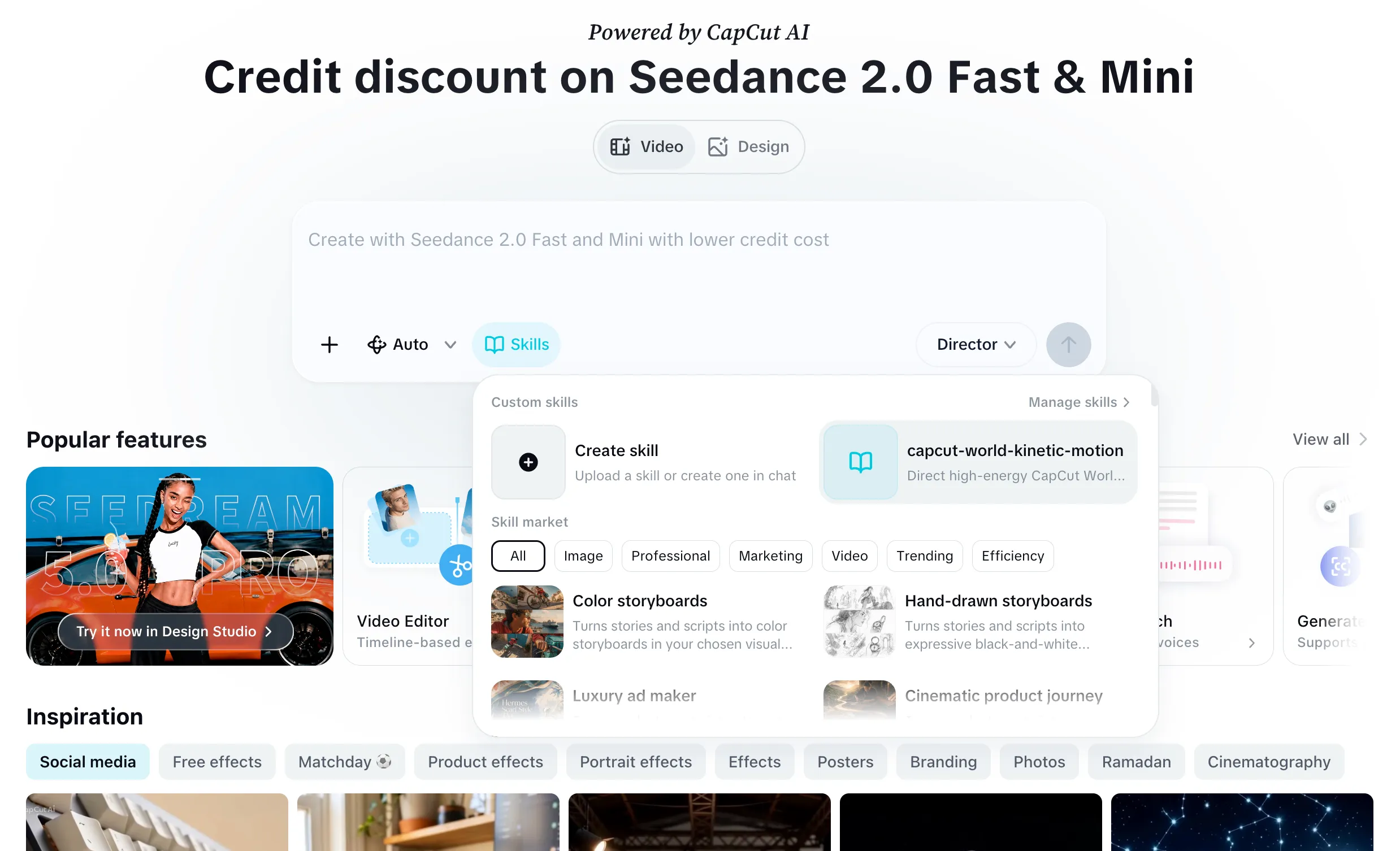

Of the ideas CapCut brought together in Singapore, Skills is the most consequential. It shifts the unit of reuse from the output toward the method.
What Templates Share
A template lets someone reuse a finished structure: an arrangement, effects, transitions, and other elements close to the completed result. What it does not necessarily carry is the reasoning behind that result — the sequence of decisions, the workflow, or the method used to maintain a consistent look.
What Skills Shares
The Skills feature allows creators to save, reuse, and share styles, workflows, and techniques. The unit shifts from what was made toward how it was made.
CapCut’s own example is filmmaker Vee Camallere and the AI series Featherweight, which has generated more than 25 million views. CapCut says the color-grading process was saved as a Skill, allowing the same look to be recalled across episodes.
(Source: Helping Community Members Iterate Together | CapCut Newsroom)
| Templates | Skills |
|---|---|
| Reuse a finished structure | Reuse a production process |
| Output | Process |
| “What was made” | “How it was made” |
| Finished structures circulate | Methods and know-how become reusable |
Anyone working to a deadline knows that a repeatable process can be more valuable than a one-off result. Color treatment. Character consistency. Brand style. Product-visual pipelines. Repeatable production routines for social content. If these can be stored and shared through Skills, experience that once lived inside one creator’s head or project files can become a reusable asset.
At that point, the question “Is CapCut becoming a Creator OS?” begins to feel less theoretical. It is still too early to make that claim outright. But a platform that increasingly stores not only what creators make, but also how they make it, is doing something meaningfully different from a conventional video editor.
Singapore Was an Integration Event, Not Simply a Launch Event
It is important to be precise about what appeared when. Skills and the surrounding infrastructure did not suddenly emerge on the day of CapCut World Singapore.
| Date | Key Development |
|---|---|
| July 8, 2026 | Seedream 5.0 Pro — image model with region-based editing, layer separation, multilingual text generation, and other capabilities |
| July 31, 2026 | Dreamina Seedance 2.5 / Dola Seedream 5.0 Pro — announced alongside C2PA Content Credentials, invisible watermarking, and visible AI labels |
| August 10, 2026 | Skills rolled out for Design Studio, positioning repeatable workflows as reusable creative capabilities |
| September 4–6, 2026 | CapCut World 2026 Singapore |
These foundational releases arrived over roughly five weeks, followed by CapCut World less than four weeks after the Skills rollout. The generative models, provenance measures, and process-reuse mechanism had therefore appeared separately before creators arrived in Singapore.
CapCut World was less a stage for unveiling every capability for the first time than a stage for assembly — a place where previously separate pieces were shown as parts of one creative workflow.
That changes the more useful question from “What was announced?” to “How do the parts connect?”
(Sources: Seedream 5.0 Pro | CapCut / Dreamina Seedance 2.5 and Dola Seedream 5.0 Pro | CapCut Newsroom / CapCut Design Studio Levels Up | GlobeNewswire)
From AI Lab to Edit Pilot: An Integrated Creative Workflow
Say hello to the New Way of Content Creation with CapCut! 👏
Built on the video editor you already know, CapCut is now an all-in-one AI-powered creative platform, with video and image editing, AI generation, filmmaking and design together in one place, on mobile, desktop, web… pic.twitter.com/Vork6j69Il
— CapCut (@capcutapp) September 9, 2026
The more consequential part of CapCut’s AI strategy may not be any single model. It is the effort to carry creative context from the first idea through to the final edit with as little interruption as possible.
The Creative Pipeline
Idea → AI Lab → Infinite Canvas → story, character, and shot development → AI generation → multitrack editing → Edit Pilot → final output
AI Lab supports ideation in natural language. Infinite Canvas is positioned as a space where stories, characters, shots, and scenes can be developed. That context and those assets can then move toward the editing environment, where Edit Pilot assists the production process. Dreamina Seedance supports video generation, Dola Seedream supports image generation, and Seed Audio covers sound generation.
CapCut says it now offers more than 85 AI tools, that more than six billion images, video clips, effects, and other outputs have been generated in 2026, and that more than seven million creators use AI features each day.
(Source: Empowering People Throughout the Creative Process | CapCut Newsroom)
The number 85 is not the most interesting part. Eighty-five disconnected tools would still leave creators exporting assets, re-entering prompts, and rebuilding context between environments. The more important question is how much of that friction can be removed.
Generative AI is moving deeper into the editing environment, while ideation and story development are also moving closer to the same workflow. That is more significant than simply adding another AI feature to an editor.
AI Provenance Is Becoming Part of the Product
The deeper generation is integrated into a platform, the more important provenance becomes. What was AI-generated? And how can that origin be communicated?
CapCut has outlined transparency measures including invisible watermarking, C2PA Content Credentials, and visible AI labels. These measures were introduced alongside its model announcements rather than only as a separate policy layer.
Combining increasingly capable generation with reliable provenance remains an industry-wide challenge. For professional AI creators, provenance is becoming a consideration alongside output quality itself.
(Source: Giving Creators More Control with Dreamina Seedance 2.5 and Dola Seedream 5.0 Pro | CapCut Newsroom)
CapCut AI Creators Hackathon Case Study: ROOM 0 in 50 Minutes

| Title | ROOM 0 |
|---|---|
| Created at | CapCut AI Creators Hackathon / CapCut World 2026 Singapore |
| Runtime | 1 min 30 sec |
| Production time | Approx. 50 minutes |
| Evaluation | Participant vote after all works were screened |
| Recognition | Best Main Character Design — Hackathon |
| Team | aratama 璞 / Bird / Okada / SHAINA |
| Special thanks | amity_sensei |
| Synopsis | Four creators race through a series of impossible games against a deadly countdown. |
The hackathon became one of the most revealing parts of the event because it put the creative workflow under real production pressure. A workflow can appear seamless on a keynote stage; a 50-minute deadline makes its practical bottlenecks much easier to see.
The Production Process — Nine Steps
Before the Hackathon: From Team Announcement to the Night Before
- Teams announced several weeks ahead
We learned who we would be working with. None of us had met in person. We had exchanged messages on X, but they were largely logistical rather than creative. - A story meeting at a Singapore street-food stall
Three of us were able to meet after arriving and went to a street-food stall, where we talked for several hours. That was where the central idea emerged: take our own situation — creators who had to finish something before the clock ran out — and turn it into the film itself. A death game.
Event Day: Before the Clock Started
- Bringing our own material
The full team effectively introduced themselves for the first time that day. Everyone brought original character sheets, background assets, and other material, including our original CapCut Man character. We were not inventing every character from scratch during the hackathon. Each creator brought characters they had already been developing independently.
The Hackathon: 50 Minutes
- Start
We had roughly 50 minutes. Teams were seated close together, with staff, participants, and other people around us able to see the work unfolding. That created a kind of live pressure very different from a normal production environment. - Shot design
We worked backward from a 90-second target: how many scenes were required, how long each could run, which characters would appear, and what each prompt needed to accomplish. The governing question became less “What can we make?” and more “What can we actually finish?” - Parallel generation
We divided the scenes and generated them simultaneously. Usable shots went directly into the edit; weaker ones were regenerated. Waiting for every shot to reach an ideal state would have meant missing the deadline.
Structuring the film around one game per scene also made selection easier because each sequence could be judged independently. - Music
The music was also created on-site. A 90-second film needed an audio arc as well as a visual one, so sound had to develop alongside generation rather than afterward. - Editing while still generating
Finished shots went straight onto the timeline as they arrived. We did not wait until generation was complete before starting the edit. Under this kind of deadline, that parallelization was critical. - Submitting at the deadline
The title and English one-line introduction still had to be written, followed by the upload and submission itself. A concept is not a finished film. Generated footage is not a finished film. The work is finished when it is delivered.
The films were screened immediately afterward and put to a participant vote. We had imagined more games and additional ideas for the ending than we ultimately used. In retrospect, what we were forced to cut shaped ROOM 0 as much as what remained.
Four creators trapped in a deadly countdown must complete a series of impossible games—only to discover that the final test was never about survival, but about creating the next moment together.
Why ROOM 0 Received Best Main Character Design
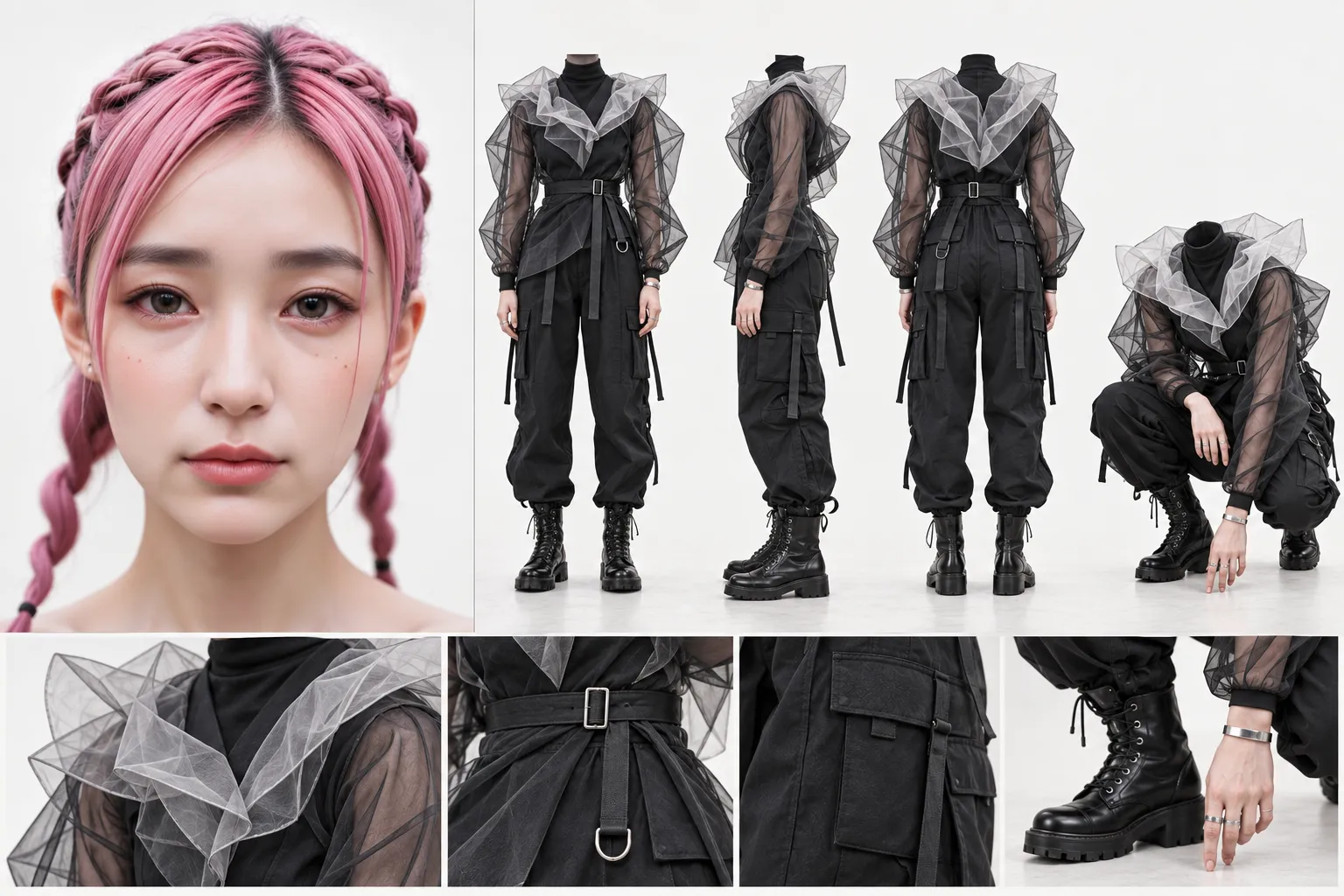

ROOM 0 received Best Main Character Design within the hackathon. Given the way the film was made, the recognition was closely connected to the production method itself.
Four Separate Creative Worlds, One Film
No single creator designed the full cast from scratch in one unified style. Each character came from a different creator’s existing practice. Different visual languages. Different settings. Different creative sensibilities. We used the character sheets almost as a shared production specification and brought those characters together inside a single 90-second film.
Character consistency remains a major challenge in generative video. Producing one compelling character is not the same problem as preserving that character as recognizably the same person across multiple shots.
That is why character sheets matter. A front view alone is rarely enough. Angles, expressions, clothing, body proportions, and identifying details all help establish a stable reference. The objective is not to redesign the character with every generation, but to define an identity standard first and generate against it.
ROOM 0 is therefore better understood not as a film that invented characters with AI, but as a film that integrated existing character IP through an AI workflow. As generating a character becomes easier, questions of authorship, ownership, identity, and consistency become more important rather than less.
Creator Awards: How CapCut Recognizes Creator Activity
CapCut World 2026 — DAY 2.2 🇸🇬
19:00からは、Capella Singaporeで Red Carpet, Awards Gala & After Partyへ。世界中から集まったクリエイターたちが一堂に会し、Red CarpetからCreator Awards、そしてAfter Partyまで続く特別な夜でした。
CapCut… pic.twitter.com/svJYunCYXj
— aratama 璞 (@aratamadao) September 6, 2026
The Creator Awards took place at Capella Singapore on the evening of September 5. What they recognized was different from what the hackathon evaluated.
The Creator Awards spanned eight categories: Asset Member Favorite, Boundless Explorer, Creative Impact, AI Visionary, Creator of the Year, Top Partner, Community Star, and Trendsetter.
The category names themselves suggest that this was not simply a competition between individual finished works. Categories such as Top Partner, Community Star, and Trendsetter point toward ongoing platform participation, community contribution, and influence over time.
Vietnam’s state broadcaster VTV reported that 20 Vietnamese creators were recognized across the eight categories. Kim Hoa was named Creator of the Year, while BatToS, BMSound, Phong AI, Shjn, and Bé Cừu were among the AI Visionary recipients.
(Source: Việt Nam dẫn đầu CapCut World Award tại Singapore | VTV)
Why Were 20 Honorees From Vietnam?
This should not be reduced to a simplistic comparison in which Vietnamese creators are somehow “better” than creators elsewhere. The Creator Awards were not designed around finished-work quality alone.
A more useful lens is the depth of the regional creator economy. How many creators supply templates? How many maintain an ongoing relationship with the platform? How connected are creators to one another as a community? And how effectively does the platform discover, support, and recognize creators in each region?
Award counts are not a clean proxy for the overall health of a creative scene. But 20 honorees is still a meaningful reminder that a creator’s standing is not determined by production skill alone. Creation, publishing, community participation, distribution, and sustained activity increasingly operate as separate but connected layers.
CRE[AI]TE: Evaluating AI Work as Creative Work
The canvas is ready. What will you CRE[AI]TE?
We are excited to launch CapCut’s 1st AI Festival, a global celebration of original work and the imagination AI makes possible.
Submissions are now open through August 10, 2026.
From Films and Series to Creative and Commercial,… pic.twitter.com/SHS8dl9Kbz
— CapCut (@capcutapp) June 10, 2026
While Creator Awards focus on creators and their broader activity, CRE[AI]TE evaluates finished creative work. Launched in 2026 as CapCut’s first AI Festival, it is structured as an international competition.
(Source: CapCut CRE[AI]TE 2026)
Four Categories
- Film — a complete story with characters, cinematic craft, and a clear point of view
- Series — work that builds a shared universe across multiple episodes
- Creative — visually driven, experimental work
- Commercial — spec ads and brand films for fictional or self-created brands
What is notable is that there is no separate “AI Movie” or “AI-Generated Video” category. The structure maps closely to established creative-industry formats: Film, Series, Creative, and Commercial.
AI is not the genre. What you make with it is the genre.
Cash Awards and Selection Structure
CRE[AI]TE recognizes 30 works in total: 10 Cash Awards and 20 Spotlight Selections.
| Award | Recipients | Amount |
|---|---|---|
| Grand Prix | One work across all categories | US$70,000 |
| Category Winner | One per category × 4 | US$20,000 each |
| Category Honoree | One per category × 4 | US$10,000 each |
| Student Vision Award | One student | US$10,000 |
The itemized amounts in the current Program Terms add up to US$200,000. The official Terms do not state a headline total as a standalone figure, so this report treats US$200,000 strictly as the sum of the published award breakdown.
Selected creators or teams are also listed as receiving 50,000 CapCut Credits and one year of CapCut Pro, subject to the applicable conditions. Because program terms may change, creators should refer to the latest official rules.
(Source: Program Terms | CapCut CRE[AI]TE 2026)
The Judging Criteria Matter More Than the Prize Money
The most revealing part of CRE[AI]TE is not the size of the prizes. It is what the work is judged on.
The Program Terms list Human Vision and Intent, Story or Concept, Craft with AI, Originality and Imagination, Taste, Sound, and Overall Execution as judging criteria.
In other words, the center of gravity is not “How much AI did you use?” It is story. Intent. Craft. Originality. Taste. Sound. Execution.
CapCut appears to be moving the evaluation of AI video away from technical demonstration and toward creative work. More importantly, that direction is expressed through category design, judging criteria, and awards — not only through marketing language.
As AI filmmaking matures, “Can you generate it?” increasingly becomes the baseline. The questions above it are familiar ones: Why this shot? Why this character? Is there a reason to keep watching? Do the picture, sound, and edit function as one coherent work?
(Source: Judging Panel Criteria | CapCut CRE[AI]TE 2026)
What Can Be Confirmed About Singapore
CapCut World’s program confirms that CapCut AI Festival screenings took place at Capella Singapore on September 5, and VTV also reported that CRE[AI]TE 2026 works were screened there.
What cannot currently be confirmed from public sources is whether the formal CRE[AI]TE winner announcement took place on that stage. This report therefore treats the screening of CRE[AI]TE / CapCut AI Festival work in Singapore as the confirmed fact and does not go beyond it.
(Source: VTV)
Hackathon, Creator Awards, and CRE[AI]TE: Three Recognition Systems
Put the three side by side and the distinction becomes much clearer.
| Creator Awards | CRE[AI]TE | Hackathon | |
|---|---|---|---|
| Primary subject | Creator | Work | Team / live production |
| Time horizon | Sustained activity | Open competition | Short, time-constrained production |
| Decision process | Not disclosed in the public materials reviewed | Jury, using published criteria | Participant vote observed on-site |
| Evaluated on | Impact, community, trends, and related activity | Vision, story, craft | Execution, collaboration, result |
| Example | Creator of the Year | Grand Prix | Best Main Character Design |
| Primary value dimension | Community | Authorship | Process and collaboration |
Calling all three simply “the awards” flattens what is most interesting about them.
One system recognizes the creator. One recognizes the work. One recognizes the ability to make something with other people, live, under pressure.
They also operate on different time horizons. A work can be evaluated as a single submission. A creator’s activity accumulates over months or years. Collaboration is tested in the room, in the moment. Different timescales require different forms of recognition.
The level of transparency is also different. CRE[AI]TE publishes its judging criteria. I observed the hackathon voting process directly on-site. The Creator Awards selection methodology was not detailed in the public materials reviewed for this article.
For clarity, ROOM 0’s Best Main Character Design was neither a Creator Award nor a CRE[AI]TE prize. It was an in-hackathon recognition. Keeping those systems separate is important to documenting CapCut World accurately.
CapCut’s Creator Community: When an Online Network Becomes Physical
The moment I remember most clearly from Singapore was not on the Capella stage. It was in the lobby of Hotel Ora, where many of the invited creators were staying — and before that, in the arrivals hall.
Creators kept appearing whose names I had previously known only from timelines. Their fields were completely different: AI film, templates, design, short-form video, fashion, visual art, marketing. People who would normally occupy separate algorithmic feeds were suddenly staying in the same hotel, riding the same shuttle, and sitting around the same table.
The same was true for the Japanese contingent. Everyone had rearranged something in their lives or work to make the trip to Singapore. Some left with results they were proud of; others may have left with frustration. Either way, after the formal program ended, many Japanese creators naturally gathered in the hotel lobby and continued talking late into the night.
“Creator community” is a term that gets used loosely. But ultimately, it comes down to people. Follower counts, online recognition, and connections are part of that picture. So is the experience of eating together in another country, creating side by side, and sharing the same setbacks and sense of achievement. That was where the value of community became tangible.
The Event Operation Was Part of the Product Experience
Watching CapCut World at close range, it would be a mistake to focus only on the stage program.
Multilingual support. International flights. Hotels. Airport reception. Dedicated shuttles. Hospitality desks. Badges, welcome kits, meals, transfers to Capella, workshops, awards, performances, the public Marina Bay Sands experience, and coordinated social campaigns around the event. There was an enormous operational layer behind the visible program.
Why Operations Matter as Product Experience
At a creative event, strong content can still be undermined by broken logistics. That becomes especially important when guests are arriving internationally. Flights, immigration, hotels, airport transfers, and on-site coordination may not appear “creative,” but failures in any of those areas can shape the entire event experience. Risk management is part of the design whether audiences see it or not.
For a creator community to operate globally, the operational layer also needs a degree of repeatability. If the creator experience changes dramatically from one city to another, it becomes difficult to sustain a coherent global community strategy.
CapCut World also continues beyond Singapore to Los Angeles and London. From a marketing perspective, the experience extends beyond campaign creative or the stage itself. The journey from a creator’s arrival through their return home can become part of the brand experience.
What Is CapCut Becoming? A Five-Layer Model
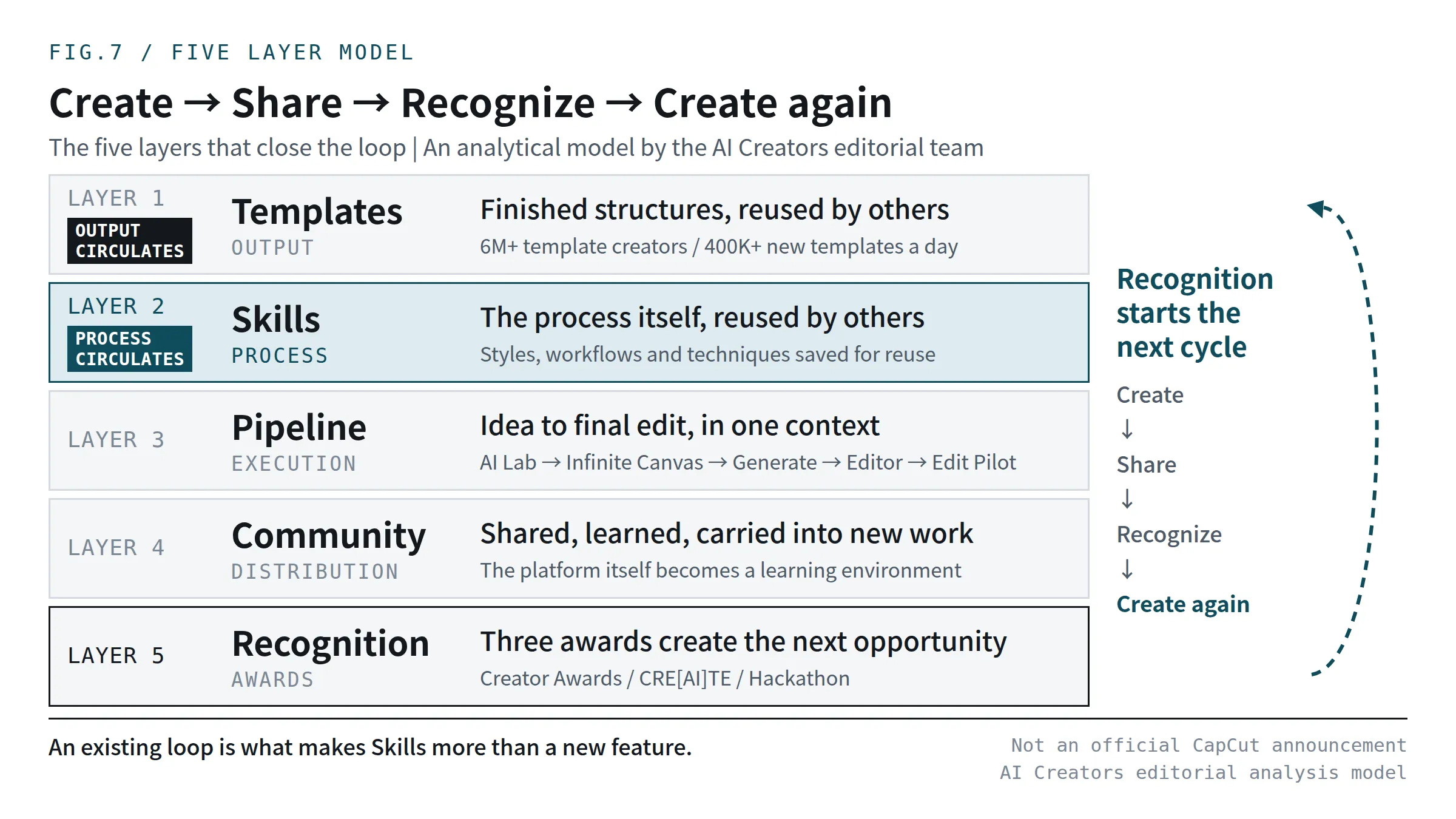

Taken together, the developments around CapCut World can be read as five connected layers. This is not an official CapCut framework or product term. It is an analytical model developed by the AI Creators editorial team based on what was shown in Singapore and on publicly available information.
Layer 1 — Output: Templates
One creator’s finished structure can be reused by another. More than six million template creators and over 400,000 new templates a day suggest that this layer already operates as a substantial economy.
Layer 2 — Process: Skills
The Skills feature moves reuse beyond the finished output toward the style, workflow, and technique behind it. If Templates circulate results, Skills turns methods into reusable assets.
Layer 3 — Execution
AI Lab, Infinite Canvas, Dreamina Seedance, Dola Seedream, Seed Audio, Editor, and Edit Pilot. Ideation, design, generation, revision, and editing are being brought closer together inside a more continuous production context.
Layer 4 — Community
Creators share Templates and use Skills to exchange methods and influence how other creators work. This layer includes distribution, but also learning. Once creators can absorb not only someone’s output but also the process behind it, the platform itself can begin to function as a learning environment. If the Skills feature scales, the significance of this layer will grow with it.
Layer 5 — Recognition
Creator Awards recognize creator activity. CRE[AI]TE recognizes finished work. The hackathon recognizes execution and collaboration under live constraints.
In a creator economy, recognition is not merely ceremonial. It creates visibility, visibility can create opportunity, and opportunity can change a creator’s role within a community. Create, share, receive recognition, create again. Recognition can be understood as the layer that closes the loop.
Why CapCut Can Connect These Five Layers
CapCut can bring these layers close together because it is not starting from zero. Skills and an integrated AI workflow are being added to an existing foundation: more than 660 million users, six million-plus template creators, over 400,000 daily templates, and more than 85 AI tools.
A strong AI model alone does not create a creator economy. Neither does a strong editor.
A sustainable loop emerges when tools, creators, reusable assets, community, and recognition reinforce one another.
CapCut already has a large reuse loop built around Templates. Extending that loop from output into process gives Skills more significance than the same feature might have on a platform without an existing creator economy.
And if creative context increasingly carries from AI Lab through to Editor, creators may have more reasons to keep their production process inside the platform. That can create network effects — but it also introduces a separate issue: platform dependency.
Can CapCut Be Called a Creator OS?
Once these five layers are visible, the question “Is CapCut simply a video editing app?” begins to feel somewhat outdated. Xiaoqi Fu, Global Head of CapCut, has described a trajectory that begins with making video creation more accessible and extends toward bringing editing, design, and newer creative tools into a more unified creative journey.
(Source: CapCut World Singapore | CapCut Newsroom)
Still, “Creator OS” is a large claim, and it would be premature to make it definitively. An operating system can imply broader conditions such as interoperability, independence from a single vendor, and a third-party developer ecosystem. What CapCut currently appears to be building is a deeply integrated creative journey inside its own services, which is different from a neutral infrastructure layer.
“Creator OS” stops being a loose analogy and becomes a claim that can be tested.
The Other Side: What It Means to Keep Your Creative Process on a Platform
An integrated workflow is genuinely convenient. It also increases what a professional creator needs to understand about where their work and process live.
CapCut’s Trust Center currently states: “All user-generated content you create on our platform belongs to you.” It also states that CapCut does not use a creator’s content or likeness for commercial purposes without consent. At the same time, it explains that sharing content on the platform requires limited permissions to enable functions such as downloading, reposting, sharing, and collaboration.
(Source: Legal Protections for Your Creative Works | CapCut Trust Center)
Neither extreme interpretation — “there is nothing to think about” or “you lose everything you upload” — is useful. A working professional instead needs a clear understanding of their own boundaries.
What goes to the cloud? Does client material belong there? Which assets are cleared for commercial use? How much of a character IP should live inside one platform? Can a workflow be moved somewhere else?
The Skills feature makes those questions more important. Backing up a finished JPEG or MP4 is relatively straightforward. But when value also lives in canvas context, AI interactions, a workflow saved as a Skill, or platform-specific editing behavior, portability becomes a different problem.
This is not unique to CapCut. It is a broader issue facing AI-native creative platforms.
Convenience and lock-in are often two sides of the same design.
For professional AI creators, the required skill set therefore extends beyond craft. It also includes judgment about how much IP, data, and working process to place inside someone else’s platform.
Seven Takeaways for AI Creators Entering the Global Market

It would be easy to end a report like this by saying that it was valuable to attend an international event. That would miss the more useful conclusion.
From a Japanese perspective, I did not leave Singapore thinking that Japan’s AI creators lack production ability. The more important challenge is how that ability connects to the world outside Japan. At the same time, many of the lessons from Singapore extend well beyond any single market.
- Enter the global market directly
Publishing work internationally online is not the same as physically entering the same room. English does not need to be perfect for work and production experience to become a shared language. At the same time, conversations and collaborations emerge in person that would never happen through a timeline alone. A creator’s positioning and demand can also look different from one market to another, which makes objective self-assessment increasingly important. - Build original IP and clear differentiation
The ability to generate visually impressive work will become less scarce. The more important question is what you already own and what is recognizably yours. ROOM 0 benefited from each creator bringing an original character into the project. Creators also need to ask what is distinctive about their perspective in a global context — and what remains distinctive at the individual level. - Treat consistency as a creative asset
Character sheets, reference architecture, prompt design, and model selection are becoming foundational techniques in AI filmmaking. But consistency extends beyond characters. It can also apply to visual language, design systems, style, and proprietary workflows. - Know how to collaborate
AI creators can increasingly complete projects alone. That does not mean solo production is always stronger. The ability to understand the strengths of other creators and established-industry specialists, divide responsibility quickly, and build toward one result becomes especially visible under time pressure. - Speed alone will not differentiate you
Generation will continue to become faster, with real-time possibilities increasingly entering the conversation. The differentiator is not what you managed to generate in 50 minutes, but what you chose in those 50 minutes. As speed becomes commoditized, direction and judgment become more valuable. - Story, direction, and taste matter more
CRE[AI]TE’s judging criteria point toward a future in which AI filmmaking is evaluated through story, originality, aesthetic judgment, sound, and execution. Model literacy still matters, but “I used the newest model” will not remain a meaningful creative proposition for long. - Distribution, community, and marketing are part of the work
Great work cannot create opportunities if it never reaches the right people. Production ability increasingly needs to be paired with creator networks, platform participation, consistent publishing, community connection, and an understanding of how the work reaches an audience.
From the Japanese creator ecosystem specifically, the larger challenge is connection rather than craft alone: English-language communication, global communities, international events, team production, media visibility, and brand collaboration.
For AI Creators as a platform, the lesson is similar. Simply listing creators is not enough. We need infrastructure that connects their expertise, creative work, and original IP with opportunities in Japan and internationally.
CapCut World Showed the Future of the Creator Economy, Not Just AI Tools
What became visible at CapCut World 2026 Singapore was not simply a list of new AI features.
Templates circulate finished structures. Skills can make creative process reusable. AI Lab, Infinite Canvas, generation, Editor, and Edit Pilot provide the execution environment. A global creator community connects the people using those systems. And three distinct recognition mechanisms evaluate creators, finished work, and live collaboration in different ways.
Bringing those elements together in one event made CapCut’s direction easier to understand than a feature list alone could.
In AI creation, the ability to generate will gradually become less valuable as a differentiator. Models improve. Generation gets faster. Baseline quality rises.
What matters next is who is making the work, what they are making, why they are making it, and how they choose to make it.
And then comes another question: who they share the method with, and which community carries it into the next project. CapCut World Singapore was significant not simply as a preview of AI tooling, but as a working sketch of the creator economy those tools are being built into.
Los Angeles is scheduled to follow Singapore, then London. Different cities will bring different creators, different work, and different creative cultures. What remains consistent — and where the format begins to change — will be worth watching.
(Sources: CapCut World 2026 / CapCut Newsroom)
FAQ
- What is CapCut World 2026?
- CapCut World 2026 is CapCut’s first global community event series, with editions in Singapore, Los Angeles, and London. It combines product experiences, creator workshops, screenings, awards, and public-facing creative programs. (Source: CapCut World 2026)
- When and where was CapCut World Singapore held?
- The public program ran at Marina Bay Sands from September 4–6, 2026. The invitation-only main event at Capella Singapore took place on September 5, 2026. (Source: CapCut World Singapore | CapCut Japan)
- What is CapCut Skills?
- CapCut Skills is a feature designed to save, reuse, and share styles, workflows, and techniques behind creative work. While Templates primarily make finished structures reusable, the Skills feature extends reuse to the process behind the work. It rolled out in Design Studio on August 10, 2026, ahead of CapCut World Singapore.
- What is CapCut CRE[AI]TE?
- CRE[AI]TE is CapCut’s first AI Festival, an international competition launched in 2026. It includes Film, Series, Creative, and Commercial categories and recognizes 30 works in total: 10 Cash Awards and 20 Spotlight Selections. (Source: CapCut CRE[AI]TE 2026)
- What is the CapCut AI Creators Hackathon?
- The CapCut AI Creators Hackathon was a team-based, time-constrained production challenge held within the invitation-only CapCut World Singapore program. The author’s team created the 90-second short film ROOM 0 in approximately 50 minutes and received Best Main Character Design.
- What is the difference between Creator Awards, CRE[AI]TE, and the Hackathon?
- They recognize different forms of creative value. Creator Awards focus on creator activity and contribution, although the detailed selection methodology was not disclosed in the public materials reviewed for this article. CRE[AI]TE evaluates finished work through published judging criteria and a jury. The on-site hackathon evaluated live team production, with participant voting after all works were screened.
- How many people attended CapCut World Singapore?
- According to CapCut, more than 300 creators, industry professionals, and CapCut team members attended in Singapore. The number does not refer to creators alone. (Source: CapCut Newsroom)
- Which AI tools did CapCut highlight at CapCut World Singapore?
- CapCut highlighted a workflow involving AI Lab, Infinite Canvas, Edit Pilot, and related creative environments, alongside AI models including Dreamina Seedance for video, Dola Seedream for images, and Seed Audio for sound. CapCut says it now offers more than 85 AI tools. (Source: CapCut Newsroom)
- What is ROOM 0?
- ROOM 0 is a 90-second short film created at the CapCut AI Creators Hackathon in Singapore. Four creators brought original characters into a single story built around a deadly countdown and a series of game-like challenges. The film was completed in approximately 50 minutes and received Best Main Character Design.
- Where is CapCut World going next?
- After Singapore, CapCut World is scheduled to continue in Los Angeles in October 2026 and London in November 2026. (Source: CapCut World 2026)