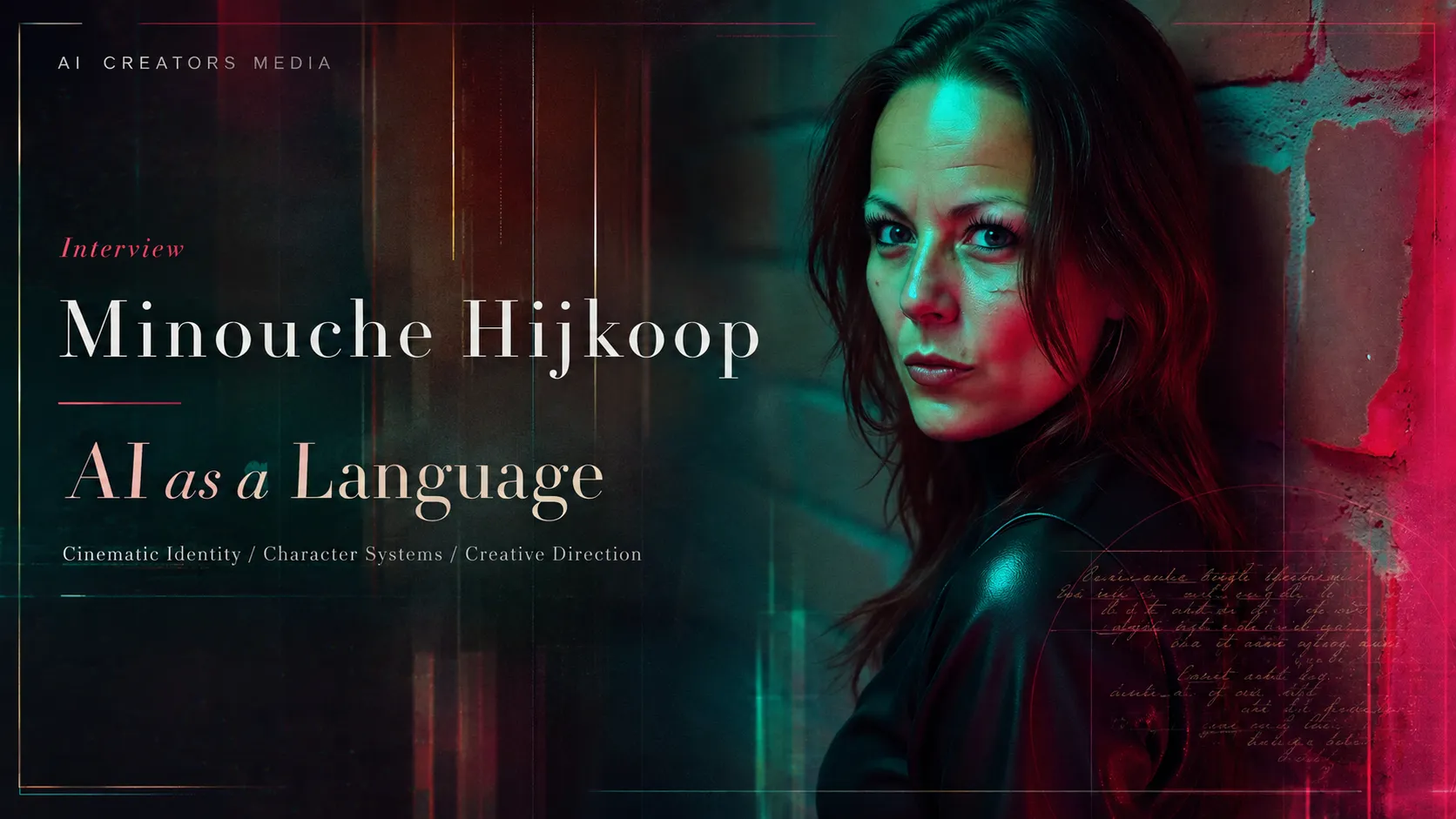
Generative AI has made it easier than ever to produce a striking image or a beautiful shot. But being able to generate something beautiful is not the same as building a world that stays with an audience.
What AI creative work increasingly requires is not prompt technique alone. It calls for a visual language, emotional design, character consistency, narrative clarity, and an identity that runs through the whole piece.
For this feature, AI Creators spoke with Minouche Hijkoop, a Netherlands-based AImaginist and VFX Prompt Designer. Minouche is the founder of the AI cinematic-identity studio Shine by Nous and co-founder of PHI, a project she created with the Japanese AI creator Kasamacura. As one of the first twenty Adobe Firefly Ambassadors worldwide, and working across more than eighteen major AI platforms, she explores what AI-driven film, character design, and cinematic identity can become.
The interview is conducted by aratama 璞, an AI Creative Architect / Artist, who explores the core of Minouche’s thinking: what it means to treat AI as a visual language, and where AI-native production is heading.
Table of Contents
Profile
Minouche Hijkoop | AImaginist / VFX Prompt Designer
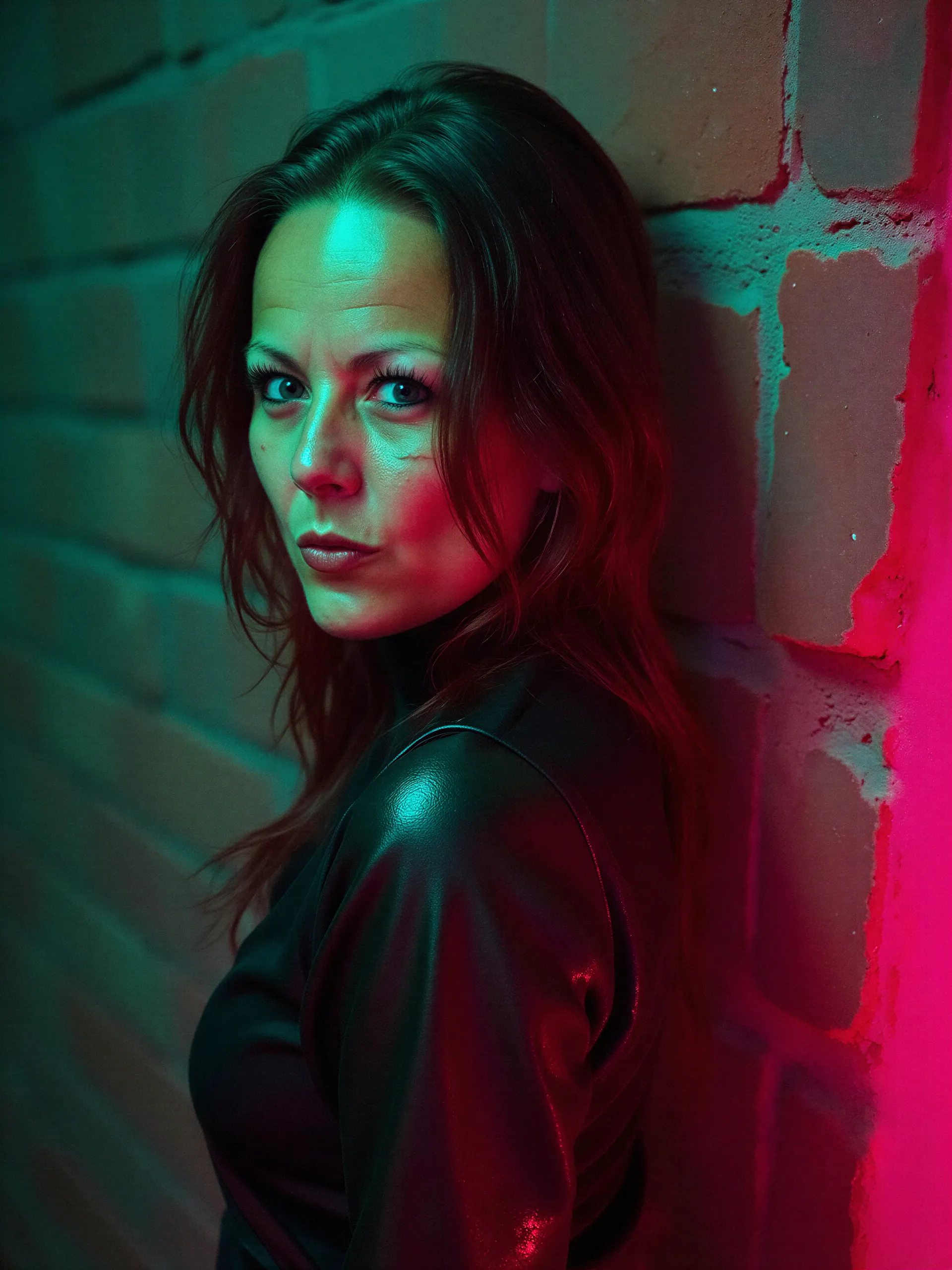
Minouche Hijkoop is a Netherlands-based AI Artist / AImaginist / VFX Prompt Designer. She is the founder of the AI cinematic-identity studio Shine by Nous and co-founder of PHI, a project she created with the Japanese AI creator Kasamacura.
Her work centers on high-impact AI image and film production, spanning visual storytelling, style development, cinematic identity, character systems, and VFX prompt design.
As one of the first twenty Adobe Firefly Ambassadors worldwide, she works with a range of major AI platforms—testing new features, providing feedback on user experience, and exploring how AI fits into professional production. Her work was selected for the AI Film Awards Cannes 2025 and named a finalist at the Bali International AI Film Festival 2025.

Chapter 1: Where an AI Creator Really Comes From
Minouche’s path did not begin in art or film. Before generative AI, she worked as a technical manager in building services engineering—handling structure, planning, cost calculations, project proposals, and the technical problems clients brought to her.
We tend to picture AI creators as coming from video, design, or art. Minouche’s background suggests something else: that creativity in the AI era can also grow out of engineering, management, problem-solving, craft, and comedy—fields that look, at first, unrelated.
aratama 璞
To start, tell us about your background before you moved into this work. How does your experience before generative AI feed into the visual work you make now?
Minouche Hijkoop
If someone had told me a few years ago that I would work in AI, I probably would not have believed them.
At the time, I worked as a technical manager in building services engineering. My job involved structure, planning, cost calculations, project proposals, and solving technical problems for clients.
Accuracy and attention to detail were essential, because one small mistake could affect the entire outcome.
Collaboration was equally important. In 2021, my team was named the Netherlands’ Superteam during De Slimste Handen van Nederland. That recognition was based on trust, communication, and solving complex challenges together.
Outside work, I designed personalized clothing with heat transfer vinyl and rhinestones, and I wrote and performed stand-up comedy. AI unexpectedly brought those different experiences together—technical precision, visual design, timing, and storytelling now all shape my creative process.
When health problems changed my career, generative AI opened a completely new path. It became the medium where technology, creativity, and storytelling finally came together.
For Minouche, AI was never just another production tool. It became a language that reconnects experiences that used to sit apart. In the AI era, a cross-disciplinary career is not a detour to be discarded—it becomes raw material for judgment. Engineering precision, comedic timing, the maker’s eye from clothing design: the real question is how to re-edit all of that inside a single medium. That is where the entry point to AI creative work turns out to be more than “adapting to a tool.”
Chapter 2: What “AImaginist” Actually Means
Minouche describes her own role as AImaginist—a word for a practice that “AI Artist” or “Prompt Engineer” alone could not capture.
aratama 璞
You describe yourself as an AImaginist. What do you mean by that term?
Minouche Hijkoop
For me, an AImaginist is someone who uses AI to turn imagination into visual reality. I created the term because no existing title fully describes what I do. My work combines art, technology, storytelling, direction, visual research, worldbuilding, and production.
I do not begin with a tool. I begin with an idea, an emotion, or a world that does not yet exist. I then explore how to make that vision visible: how a character looks and moves, which lighting creates the right mood, which camera angle strengthens the emotion, and how separate images can become one coherent story.
Prompts are only one part of that process. Selection, iteration, direction, consistency, and post-production are just as important.
I therefore see an AImaginist less as one fixed profession and more as a creative connector. It describes someone who brings human imagination and generative technology together. The tools may change, but the purpose remains the same: making visible what previously existed only in the mind.
The heart of her approach sits in one line: “I do not begin with a tool.” In the generative-AI space, the conversation usually leads with model names, features, prompts, and updates. But the thing that makes a work hold together starts on the other side—with emotion, with a question, with a discomfort that has not yet found words. AImaginist is, in part, a way of pulling the starting point of creation back from the tool and toward the imagination.
Chapter 3: AI as a Language, Identity as Signal
One line from Minouche’s profile stays with you:
AI as a language. Identity as signal.
Treat AI not as a mere generator but as a new visual language; and treat the creative signature that runs through a body of work as its identity. These two ideas are the foundation of how she works.
aratama 璞
“AI as a language” and “Identity as signal” read like a very deliberate statement. What does it mean, for you, to treat AI as a visual language?
Minouche Hijkoop
For me, AI is not a replacement for creativity. It is a new visual language for making ideas visible. Like photography, film, or animation, generative AI has its own grammar.
You learn more than prompts. You learn rhythm, composition, camera logic, lighting, movement, and emotion. The better you understand that language, the more clearly you can communicate a creative vision.
“Identity as signal” means the creative signature that can be felt throughout the work. It appears in the way a scene moves, the choice of colors, the camera angles, the atmosphere, and the rhythm of the edit. Sometimes you can recognize a creator’s work without seeing their name. That recognition is identity.
This is why I rarely create from a single prompt. I build systems in which characters, environments, cinematography, and style support one another. When these elements speak the same language, the result becomes more than a collection of beautiful images. It becomes a world with its own character and a recognizable visual identity.
Generative AI has sharply raised the speed at which anyone can reach a high-quality image. That is exactly why the value of a work shifts from one-off beauty to authorship. “Identity as signal” names that authorship precisely. What you choose again and again, what you avoid, what rhythm and air you leave across the whole piece—as AI levels more of the craft, this consistent sum of decisions becomes the one signal that sets a creator apart.
Chapter 4: Cinematic Identity Is the Personality of a Story
A central theme in Minouche’s work at Shine by Nous is AI-driven cinematic identity. It is not about making something look filmic; it is about designing the personality of a story—its emotional flow, its visual language, its consistency of style.
aratama 璞
What does cinematic identity mean to you? How do you build a visual world that feels genuinely alive rather than generic?
Minouche Hijkoop
For me, cinematic identity is the personality of a story. It begins with emotion, not with a prompt or a tool. Before creating anything, I first ask what the audience should feel. Only then do I begin shaping the visual world around that emotional goal.
Cinematic identity is built through many connected choices: color, lighting, camera work, composition, rhythm, textures, characters, and movement. Individually, these may seem like small details, but together they determine whether a world feels believable or generic.
I spend a great deal of time researching references, testing styles, and building a visual language in which every element strengthens the others. My aim is for viewers to recognize the atmosphere or style before they even see a title or logo.
Generative AI changed what felt possible for me. It brought technology, storytelling, and imagination together in a way that felt natural. It did not feel like discovering only a new tool. It felt like discovering a creative language that finally matched the way I think.
The detail worth noticing is the order of work. Most AI production starts from “make a good image.” Minouche starts by fixing the emotional goal—what the audience should feel—and works backward from there to color, light, camera, and texture. Cinematic identity is not the beauty of any single look; it is what emerges when every visual decision is aligned in one direction from an emotional foundation. Reverse that order, and the world falls back into surface-level prettiness.
Chapter 5: VFX Prompt Design Is Creative Direction
“Prompt” is often heard as the single line you type into an AI. For Minouche, VFX prompt design means something wider: direction across the whole of production—camera, lenses, light, texture, scale, physics, emotion, and post.
aratama 璞
As a VFX Prompt Designer, how do you think about prompts? What separates this from simply writing a good sentence?
Minouche Hijkoop
VFX Prompt Design is very different from simply writing one good prompt. The term “prompt engineer” can suggest that the work is about finding a perfect sentence, but in reality the process often begins after the first generation.
For me, VFX Prompt Design is a form of creative direction. I think about camera movement, lenses, composition, lighting, materials, scale, physics, continuity, and emotional tone. I also need to understand how different AI models behave, because the same idea may require a completely different approach in another tool.
A strong prompt system depends on iteration. I analyse results, adjust details, and often test many versions before a scene feels right.
I also consider how each shot will function in the final production. Post-production remains essential for compositing, motion graphics, refinement, fixing imperfections, and creating consistent movement. AI provides important building blocks, but the professional result comes from combining AI, direction, craftsmanship, and traditional production tools within one coherent workflow.
What she describes is a view in which the prompt is an entrance, not the work. The stages that begin after the first generation—deciding what to keep and what to cut, iterating, compositing, fixing, connecting one shot to the next—are what set the final quality. In VFX especially, generating a flashy effect is not enough to make a shot feel cinematic. Eye-line, the visual weight inside the frame, continuity between shots, the link to sound and edit: only when those are designed does a sequence become a film. AI is a powerful supply of material, but the direction that binds it stays on the human side.
Chapter 6: Turning Fragmented Ideas into Production-Ready Direction
AI makes the early visualization of ideas dramatically faster. But being able to output quickly is a different thing from converting fragmented moods and concepts into a coherent visual system.
aratama 璞
Many creative teams have a mood, a concept, an emotional direction—yet not a full visual world. How do you translate those fragments into production-ready visual direction?
Minouche Hijkoop
I work strongly from emotion, so before generating any images, I first try to understand what a scene or story should make the audience feel. That emotional intention becomes the foundation of the visual direction.
Many clients or creative teams begin with fragments: a mood, an idea, a reference, or a feeling they want to communicate. My role is to connect those fragments and turn them into a coherent visual system. This often starts with developing a story, script, moodboard, or storyboard in which every choice supports the intended emotional impact.
AI is extremely valuable in the early stages of a project because ideas can be explored, tested, adjusted, and presented much faster. However, the technology does not replace the creative translation itself. You still need to understand storytelling, psychology, and emotional nuance, and you must be able to direct the tools clearly.
Used well, AI helps transform an abstract concept into a visual world that can support pitching, creative development, planning, and eventually full production.
The key term is Minouche’s own: creative translation. AI shows ideas quickly, but speed does not guarantee depth. Line the fragments up as they are and you get a collage of mood boards. The work is to bridge scattered impressions across different layers—emotion, story, image, production process—and bind them in a single direction. That translation is becoming a core competence for the director or producer of the AI era.
Chapter 7: Making Characters and Worlds That Feel Alive
An AI-generated character needs more than an appealing face. How it moves through a story, what it feels, how it changes: without that continuity, a character stays a beautiful still.
aratama 璞
You talk about building story-based worlds and character systems rather than generic AI output. What does it take for an AI-generated character or world to feel alive?
Minouche Hijkoop
For me, AI creation is not mainly about producing individual images. What interests me most is building complete stories, cinematic productions, and visual worlds that feel alive.
A character needs more than an attractive face or design. It needs personality, emotion, body language, and recognizable behavior. Before generating images, I think about who the character is, how they move, what they feel, and how they develop throughout the story. These choices create the foundation for visual consistency.
The same applies to the world around the character. Lighting, color, cinematography, architecture, sound, atmosphere, and pacing all need to support one another. Only then does the world feel believable.
Consistency remains one of the greatest challenges in AI production. Maintaining the same character, style, and atmosphere across many scenes requires a structured workflow, constant iteration, and often post-production.
For me, AI is simply a tool. The real goal is immersion. When the audience forgets how the work was created and becomes absorbed in the story, the world has truly come to life.
In AI character work, the attention usually falls on one kind of consistency—”can you hold the same face?” Minouche is asking about the step beyond it: is the character behaving as the same being? Expression, timing, reaction, growth, the link to sound—as those accumulate, a character turns from an interchangeable visual asset into a specific presence an audience remembers. AI-native character work is expanding beyond exterior design into the design of behavior and emotional continuity.
Chapter 8: There Is No Perfect AI Tool
Minouche works across more than eighteen AI platforms—Adobe Firefly, Runway, Kling, HAILUO.AI/Minimax, Wonder Studios, and others. What that experience reveals is a plain reality: there is no perfect tool.
aratama 璞
As a creative partner across several major AI platforms, what makes an AI tool genuinely valuable for professional production?
Minouche Hijkoop
Working with more than eighteen AI platforms has taught me that there is no perfect tool. Every platform has different strengths and limitations, so I focus less on popularity and more on which tool fits a specific stage of production.
For professional creators, model quality alone is not enough. A valuable tool must be reliable, offer meaningful creative control, and fit smoothly into an existing workflow. Important features include consistent results, strong character references, accurate camera control, flexibility, and an intuitive user experience.
Creative partners can help because we use these tools in real production situations. We see where workflows fail, which features save time, and which limitations create problems for creators. That practical feedback can help companies build better products, not only better models.
Responsible development is equally important. Transparency, respect for creators, and serious attention to community feedback are essential. The best innovation happens when developers and creators work together, with both technical progress and real creative needs in mind.
Tool evaluation often leans on image quality and generation speed. But what the field actually asks is not raw model performance—it is character reference, camera control, stability, how well a tool slots into team production, and how it connects to post. Only when these line up does AI move from “experiment” to “production environment.” And what accelerates that shift is feedback from creators who feel the friction in real production.
Chapter 9: Adobe Firefly and Responsible Creative AI
As one of the first twenty Adobe Firefly Ambassadors worldwide, Minouche has followed Firefly’s development from an early stage—a vantage point on how generative AI moves from experimental technology into professional creative workflows.
aratama 璞
You’ve watched generative AI enter professional production up close as an Adobe Firefly Ambassador. What should responsible, creator-friendly AI look like?
Minouche Hijkoop
As one of the first twenty Adobe Firefly Ambassadors worldwide, I have been able to follow Firefly’s development from an early stage. This gave me valuable insight into how generative AI is becoming part of professional creative workflows rather than remaining only an experimental technology.
For professional use, trust is essential. Artists, brands, and production teams need reliable tools, transparency, and workflows that connect smoothly with existing creative software. AI should support creativity, not replace it or force creators into disconnected systems.
One of my most memorable experiences was attending Adobe MAX in Los Angeles in October 2025. Meeting other ambassadors in person reminded me that behind every AI tool are real people: artists, developers, designers, filmmakers, and creators working toward meaningful progress.
Responsible AI also requires listening to the people who use these tools every day. Their feedback helps improve usability, creative control, accessibility, and production quality.
Creator-friendly AI should remove technical barriers and give people more time for storytelling, emotion, and ideas. That is where I believe AI can make the greatest difference.
Discussion of AI tends to emphasize efficiency and automation. Minouche points the other way. AI is most valuable not when it takes creativity away from people, but when it gives them more time to spend on emotion, story, and ideas. The more a tool absorbs the technical barriers, the more a creator can concentrate on judgment and expression. Responsible AI, in that sense, is a design philosophy that protects this reallocation of time.
Chapter 10: Can AI Film Move Beyond Technical Spectacle?
Minouche’s work was selected for the AI Film Awards Cannes 2025 and named a finalist at the Bali International AI Film Festival 2025. The international AI-film scene is expanding fast—and still in transition.
aratama 璞
How do you see the international AI-film and AI-creative scene right now? What will it take for the field to mature beyond technical spectacle?
Minouche Hijkoop
It is a great honor that my work was selected for the AI Film Awards Cannes and that I was a finalist at the Bali International AI Film Festival. These festivals show how quickly AI is developing as a creative medium and how many creators worldwide are exploring new forms of storytelling.
At the same time, the field is still in transition. Much attention remains focused on technical spectacle: impressive images, complex prompts, and dramatic effects. That is understandable, but audiences do not remember the technology itself. They remember the story and the feeling it leaves behind.
The work that stands out to me is not always the most technically complex. It is the work in which the technology becomes almost invisible and fully serves the characters, emotion, and narrative.
I believe the next stage will depend on stronger collaboration between filmmakers, writers, editors, VFX artists, sound designers, and AI specialists. As the technology becomes more stable, the focus should shift from how something was made to why it was made. That shift will help the field mature.
In its early stage, AI work draws attention to “how it was made”—which tool, which prompt, how hard the technique was. As a culture matures, the question moves to “why it was made” and “what it leaves behind.” Whether a work survives once the technology becomes invisible—as story, emotion, and character—is the test. More work that can withstand that question is what moves AI creativity from a passing trend toward a lasting creative culture.
Chapter 11: PHI, Japan, and Cross-Cultural Collaboration
Minouche co-founded the project PHI with the Japanese AI creator Kasamacura. It began not from a business plan but from a shared creative vision.
aratama 璞
Tell us about PHI, the project you co-founded with Kasamacura in Japan. What vision did it grow from, and how has the collaboration with Japan shaped your work?
Minouche Hijkoop
PHI was born from a shared creative vision rather than a business plan. Kasamacura and I both wanted to create original work without being limited by trends or conventions. That shared freedom to experiment became the foundation of PHI.
Our styles are very different, and that is exactly why the collaboration works. We do not try to imitate or control each other. Instead, we encourage one another to explore ideas freely.
We have also created a shared universe in which Kasamacura’s characters, including Liv, Alice, Izarin, and XIMENA, can interact with my character Mogg. Mogg is a stubborn little green elf who believes he is always right, while almost everything he does goes hilariously wrong. We want to develop these characters into larger stories and a comedy series.
People sometimes expect Japan to have changed my visual style, but the biggest influence has not been one specific aesthetic. It has been the creative freedom of working across cultures. PHI is not about making Dutch or Japanese work. It is about creating something neither of us would have made alone.
International collaboration in AI creative work is not about blending nationalities or cultures. What makes PHI interesting is that Minouche and Kasamacura do not force their very different styles into one. They keep the difference intact and move toward expression neither could reach alone. Now that AI lets characters, worlds, images, and stories connect more flexibly, cross-cultural collaboration is shifting its weight from “mixing” toward “resonating.”
Chapter 12: The Future of AI-Native Production
Three to five years is hard to predict in AI. Even so, Minouche sees a direction: away from AI standing out as a special category, and toward AI integrated deeply into ordinary creative production.
aratama 璞
Looking three to five years ahead, how do you think AI-native visual production will develop? And what work or expression do you want to explore next?
Minouche Hijkoop
Three to five years is a long time in AI, so I am cautious about making specific predictions. I expect AI to become less visible as a separate category and more integrated into regular creative production. The main question will no longer be whether AI was used, but whether the result serves the story, the audience, and the purpose.
Creative roles will continue to evolve. Individual creators may develop ideas further on their own, while professional productions will still depend on collaboration between writers, directors, editors, VFX artists, sound designers, and AI specialists. Human judgement, taste, emotion, and experience will remain essential.
Through Shine by Nous, I want to continue creating cinematic, story-driven productions with brands and creative teams that value quality. With PHI, I want to expand our shared universe and further develop Mogg as the foundation for a larger comedic world.
I am also investing in workshops, courses, and learning from experienced professionals. Combining experimentation with deeper knowledge will help me create stronger and more purposeful work. Above all, I want to keep making work that I genuinely want to see.
“Not whether AI was used, but whether the result serves the story, the audience, and the purpose”—this is the measure for the maturity of AI-native production. The moment when AI draws attention as a special technology will pass. What remains is not a tool’s name but what a work makes people feel and what world it leaves in their memory. Minouche’s closing line—that she wants to keep making work she genuinely wants to see—is that same measure, put in its most personal form.
Authorship and the Production Environment of AI Creativity
What emerges from Minouche Hijkoop’s words is that AI creativity is not simply tool use. It is moving toward a broader creative environment—one that includes visual language, production design, character continuity, international collaboration, and responsible tool development.
“AI as a language” pulls AI away from being a means of efficiency. Like photography, film, or animation, it is an expressive language to be learned, handled, and developed. What you say in that language—what emotions and worlds you raise with it—is the question now put to AI creators.
And “Identity as signal” names authorship in the generative-AI era. The more anyone can generate a high-quality image, the more a work’s value lives not in single beauty but in the judgment, structure, rhythm, emotion, and visual signature that run through the whole.
At AI Creators, our aim is not only to introduce people who can use AI, but to surface each creator’s own visual language, production philosophy, worldview, and possibilities for collaboration—and to connect them to the next opportunity to make something. The future of AI-native expression is not decided by technical progress alone. It is shaped by human imagination, judgment, emotion, and experience, and by production environments where different talents meet.
Minouche’s practice offers one clear vantage point on that future. AI is not a replacement for creativity. It is a new language for turning what is not yet visible into something you can see.
From Introductions to Real Projects
AI Creators works to discover and introduce creators opening new forms of AI expression, to support their production, and to build collaborations with companies and organizations.
If you’re interested in AI-driven film production, character development, visual identity, advertising, content production, or international collaboration, explore the entry point that fits your goal.