Generative AI is rapidly lowering the barriers to entry in filmmaking.
Visual work that once required substantial budgets, camera equipment, and specialized production teams can now be explored by individual creators within a much shorter timeframe.
Yet being able to generate eye-catching footage is not the same as creating work that stays with an audience.
The more capable the models become, the more the questions circle back to the fundamentals.
What are we making? Why are we making it? How do we edit it, layer sound into it, and shape it into a coherent experience?
And precisely because AI creators can now move across so many disciplines on their own, the question of who they collaborate with — and how — is becoming increasingly important.
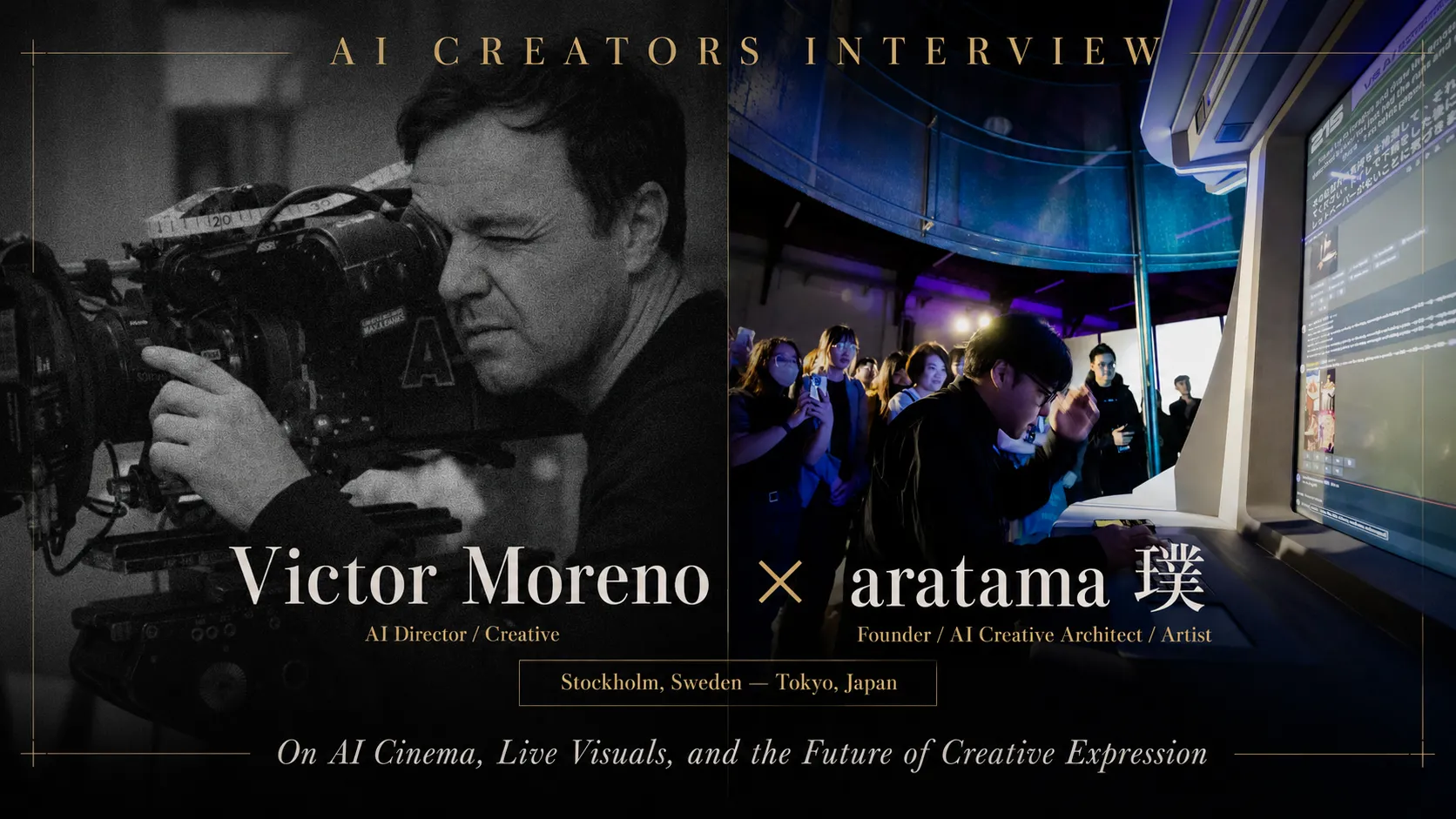
For this feature, AI Creators invited Stockholm-based Victor Moreno and Tokyo-based aratama 璞 to take part in a written dialogue.
Table of Contents
Profiles
Victor Moreno|Stockholm, Sweden

Victor Moreno is an AI creator and film director based in Stockholm, Sweden.
With a background spanning graphic design, art direction, editorial photography, and cultural journalism, he works across AI-driven filmmaking, brand expression, and narrative projects.
His clients include Telia Sweden, Netflix, Lunar Bank, and Suicide Zero.
His short narrative film Hazama (狭間) has been selected for AI Film Festival Japan, Cinema Shift Toronto, and AI Media Festival (AIMF) Los Angeles.
In 2024, he joined Runway’s Top 50 Talent Network and became a collaborator with generative AI company Luma Labs.

aratama 璞|Tokyo, Japan
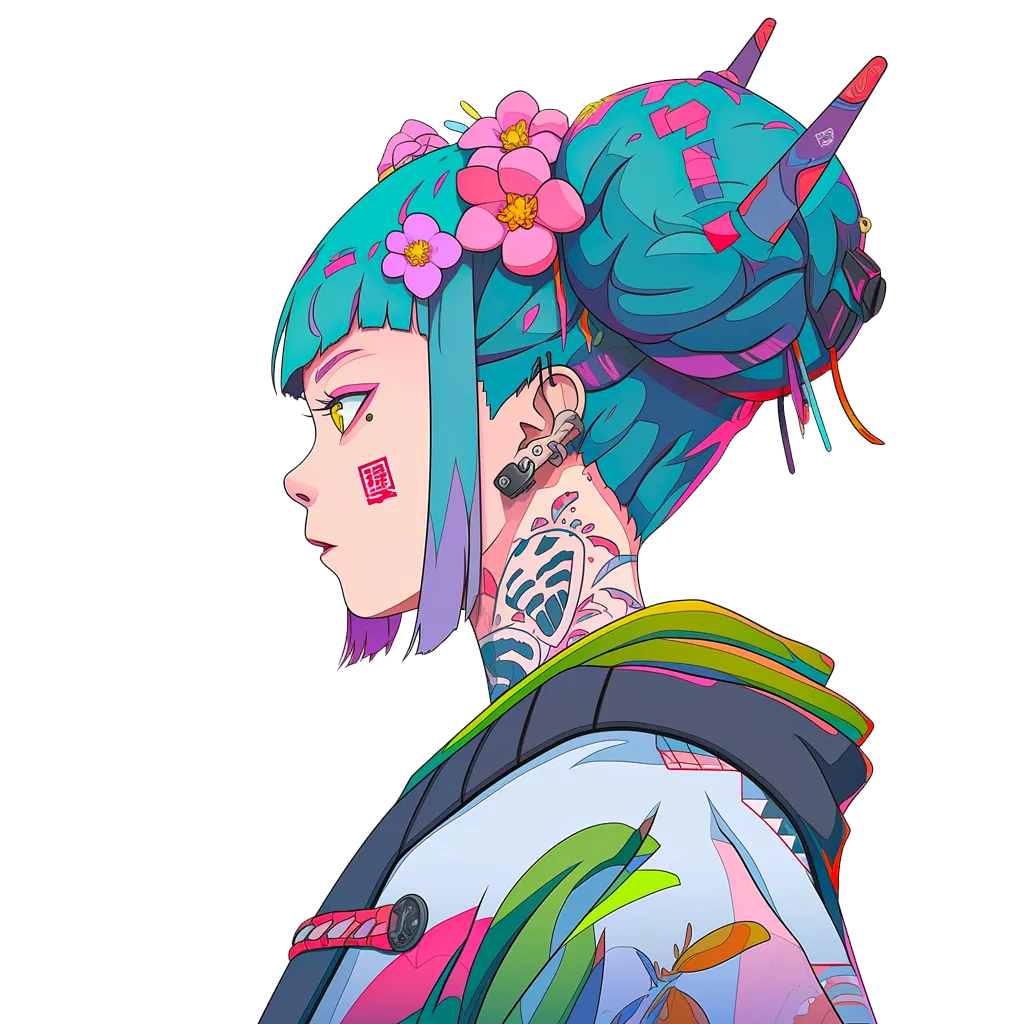
aratama 璞 is a Founder / AI Creative Architect / Artist working across generative AI, moving images, music, live performance, and spatial experience.
His practice spans character design, virtual humans, music videos, advertising, event visuals, and audiovisual works, integrating concept development, direction, experimental R&D, and production from end to end.
In recent years, rather than presenting moving-image works solely as finished pieces, aratama has been exploring ways to connect music, visuals, space, physical presence, and audience experience through an audiovisual practice using AI.
Through AI Creators, he is also involved in discovering and developing AI creators, supporting production, building connections with companies, and establishing new criteria for evaluating creative work.
Rather than treating AI simply as a tool for efficiency, he focuses on designing new forms of expression that move across established creative disciplines.

Chapter 1 AI Has Opened the Door to Filmmaking — But Quality Does Not Improve Automatically
Victor Moreno sees the democratization of filmmaking through AI first and foremost as a practical reality.
Much like the transition from film to digital, AI reduces many of the major costs once associated with film processing, camera equipment, lighting, transportation, and production crews.
As the barriers to entry fall, more people gain the opportunity to explore visual storytelling.
But that openness can also be a double-edged sword.
Victor Moreno
Generative AI is lowering the barriers to filmmaking.
The result will be plenty of noise and a lot of mediocre work.
But some beautiful work will emerge from it as well.
What matters is not simply being technically impressive.
The work needs to speak to an audience.
It needs to resonate with the person receiving it.
The Sex Pistols were not musical virtuosos.
But they had a purpose that connected with the cultural and societal moment.
Working with AI is not the point in itself.
What matters is how you incorporate those new possibilities into the creative process and the production pipeline.
aratama 璞
AI has made it possible for individuals to experiment with forms of visual expression that once required specialist production companies.
But being able to generate something and being able to create a fully realized work are not the same thing.
As the number of works increases, the weight carried by each individual piece can easily diminish.
It is no longer enough simply to make something.
We need to ask why the work exists, how it should be presented, and how it can remain in the audience’s memory.
Another major shift is that we can now devote more time to refining the intention and presentation of a work, rather than focusing solely on the labor of production.
In a world where the barriers to entry have fallen, the rarest quality is not the ability to generate content.
It is the ability to ask the right questions, form a clear intention, think critically, and make decisions.
Chapter 2 “The Model Is Just the Instrument” — What Makes Work Last Is Intention and Direction
Generative AI tools are evolving rapidly.
But as models become more capable, the ability to use a particular tool becomes less meaningful as a point of differentiation.
The question is what a creator can draw out of the model and how those elements are shaped into an experience.
This is where an individual’s accumulated skill and experience come into play.
Victor Moreno
Creative direction, taste, and intention are everything.
The model is just the instrument.
Working with AI is about taming the beast.
Owning it, bending it toward a vision.
Lately, I’ve been drawn to the word “sampler” as a way of describing how generative AI works, and I think it is accurate.
Some of my early work was built using Flux Redux, which is exactly that: taking elements, sampling them, shaping and modulating them until the result reflects what you are actually after.
That craft is no different from what musicians, directors, and artists have always done.
A lot of the most iconic work in pop culture was built on sampling.
The raw material was borrowed, but the vision behind it was entirely original.
aratama 璞
When people discuss AI-generated work, the model or the generation technique often comes first.
But using the same model does not produce the same work.
What matters is not simply receiving an output, but deciding what to keep, what to discard, how to sequence it, and how to transform it into an experience.
The value of an AI creator lies not in the number of generations they produce, but in the quality of their decisions.
Victor’s metaphor of the instrument captures this perfectly.
Chapter 3 The Fundamental Challenges That Still Remain in AI Filmmaking
AI filmmaking has advanced dramatically within a short period of time.
At the same time, essential challenges remain: consistency between shots, control over longer sequences, character continuity, natural emotional expression, and narrative structure.
Victor Moreno
Since day one of working with AI, consistency and continuity across shots, and control over longer sequences, have been the main challenges.
We are in the middle of 2026, and I have only just started working with character emotional depth, which is getting better and better as well.
Progress is extremely fast.
What is a limitation today becomes a solution tomorrow.
That is one of the great things about working with AI.
When you know what you are after, you explore the possibilities and execute.
Star Wars used matte paintings — hand-painted on plexiglass.
Working with AI is no different.
If you want to maximize the outcome, I do not think you can rely on text-to-video alone.
You want to incorporate motion capture, LoRA training, video-to-video — whatever gets you closer to the vision.
And still, I have seen beautiful accidents come from a single generation.
But you need to lift the raw material: audio sync, SFX, music, editing pace, grading — something that elevates it into a work that actually lands with an audience.
aratama 璞
In AI filmmaking, individual shots can be striking while the work as a whole feels weaker once those shots are placed in sequence.
Moving images are not simply a collection of stills.
They are an experience shaped by music, rhythm, pauses, speed, structure, and changes in space.
Improvements in model performance matter, but ultimately the question is how the entire work is designed.
How do we place the beauty of an accidental frame, or movement that cannot be fully controlled, within the structure of an experience?
That is where the essence of editing lies.
Chapter 4 AI Filmmaking Quality Depends on Workflow, Not Just the Model
Building longer, more polished sequences requires the design of an entire production process, not simply the accumulation of individual generations.
Reference images, storyboards, shot breakdowns, compositing, editing, sound, and color grading.
The accumulation of decisions made around the model shapes the final viewing experience.
Victor Moreno
For me, it comes down to reference design and editing pace.
Those are the anchors.
There is an unspoken nature to what the brain identifies in a blink.
Your job as a storyteller is not to alienate your audience with invisible elements that make them drift — to start thinking about what time it is, or what they need to do tomorrow.
Once that happens, they have already left the work.
Consistency, rhythm, dialogue, sound, grading.
Those are your allies in delivering a well-packaged story.
The real craft is knowing what you do not need to put in the frame.
Letting the audience build that part on their own.
That is where the magic happens.
Do I think the quality of AI filmmaking will increasingly depend on the production workflow around the model rather than the model alone?
Absolutely.
That said, I can also foresee genres or subgenres emerging where the raw model output becomes the aesthetic itself.
Almost like lo-fi became a genre rather than a limitation.
aratama 璞
AI rapidly increases the number of elements we are able to add.
But making a work stronger requires not only addition, but bold subtraction.
What should remain unseen?
At what point should the image stop?
How much explanation should remain?
The more possibilities AI creates, the greater the weight placed on the judgment of directors and editors.
Victor’s observation about knowing what not to put in the frame becomes even more important in an era of abundant tools.
Chapter 5 Can One AI Creator Carry an Entire Production?
AI creators can now work across a much wider range of processes than before.
Planning, concept development, visual direction, prompt design, compositing, editing, sound, narrative structure, workflow design, and distribution.
The scope of what a single creator can manage has undeniably expanded.
But that does not mean every creator should be expected to complete everything alone.
aratama 璞
AI creators can now take on many different disciplines.
But to raise the quality of the work further, I believe we need specialist teams that understand AI.
Victor, how do you see the role of the AI creator?
Victor Moreno
I see an AI creator as a director, like an orchestrator.
AI can help you push things 50, 60, even 70 percent of the way.
But that final stretch is the longest and most demanding.
Having the support of a specialized editor, sound engineer, or colorist makes a measurable difference.
Two years of working full-time with AI have shown me that.
Even in the early stages, I have been incredibly grateful to have a team around me: technical support for workflow troubleshooting, AI artists handling image retouching, copywriters, editors, and all the post-production craft that elevates the work.
What I find striking in 2026 is that large corporations still have not moved to build these teams in-house.
There is a widespread misreading of what AI filmmaking actually is — the assumption that anyone can do it.
When in-house attempts fall short, people blame the technology rather than the lack of craft and structure around it.
The US is probably ahead.
I have seen some rare opportunities in the UK as well, but they still lean heavily on engineering and technical skills: Python, workflow builders.
That makes sense when you are trying to create something scalable and sustainable.
But the expertise required to execute work as moving-image expression is just as important.
aratama 璞
AI creators sometimes carry a wider range of responsibilities than creators in more established production fields.
They can handle planning, direction, generation, editing, sound, implementation, and distribution alone.
But that breadth can also become a limitation.
Talented AI creators are often occupied with existing commissions and have too little time to develop their most ambitious work.
The important question is not simply who is talented.
What are that creator’s strengths?
What kind of support would allow the work to reach the next level?
What specialists, technologies, funding, time, and production environment are required?
The answer will differ from creator to creator.
In some cases, collaboration between AI creators may be the right answer.
In others, the work may require connections with established specialists: producers, screenwriters, editors, sound designers, colorists, engineers, animation specialists, 3DCG designers, marketers, and industry advisors.
Truly powerful AI-native work emerges when an individual vision is supported by the right collaborators, production resources, time, and funding.
For AI Creators, the challenge is not simply to showcase talented creators, but to consider how their abilities can be developed, how the right teams can be assembled, and how the work can be elevated to the next level.
Lunar Bank – “Old Bankers” TV Commercial (2025)
Client: Lunar Bank
Production company: UNCUT
Executive Producer: Fredrik Skoglund
AD: Tor Söderholm and Victor Moreno
Copywriter: Erik Bergqvist
AI team: Ib Thorub, Lars Bjurman, Victor Moreno, Simon Appel
Editor: Karim Fakih
Colorist: Filip Bergh
Chapter 6 Selection at AI Film Festival Japan and the Potential Victor Sees in Japan
Victor Moreno’s narrative film Hazama (狭間) was selected for AI Film Festival Japan.
Although he was unable to attend the screening at Tokyo Innovation Base, he describes learning that Nippon Television had attended the event and broadcast footage from the film on NTV News as an especially meaningful moment.
Victor Moreno
I genuinely regret not being able to attend the screening at Tokyo Innovation Base.
But learning that Nippon Television visited the venue and broadcast footage from my short film Hazama (狭間) on NTV News was incredibly rewarding.
Japan means a great deal to me.
That recognition felt like a real gift.
I believe in the domino effect.
One thing leads to another.
And here we are, having this conversation.
I have been lucky to visit Japan three times, both for work and for personal reasons.
Every time I am there, I have the same feeling: that I am traveling into the future.
I hope that never changes.
What strikes me most as an outsider is the coexistence of two things that rarely live together so naturally.
A deep sense of inner peace rooted in something ancient, and an equally strong pull toward the new, the innovative, and the unexpected.
That duality is rare.
In terms of opportunity, I see real potential in helping organizations visualize concepts with AI.
Precise, meticulous work that reflects how Japanese creators and companies actually think about their products.
Whether that means streamlining production pipelines in film, games, design, architecture, digital art, fashion, and animation studios, or developing creative concepts from the ground up, I think the combination of that cultural precision with an offbeat creative approach is where something genuinely interesting can happen.
I am looking forward to building more connections in Japan.
aratama 璞
Japan has a cultural foundation that not only preserves the past, but also allows sensibilities from different eras to overlap.
If AI is connected not simply to efficiency, but to Japan’s distinctive aesthetics, narratives, sound, space, and physicality, forms of expression may emerge that differ from those developed elsewhere.
The title Hazama (狭間) itself seems to resonate with the Japanese sensibility toward margins, thresholds, and the space between things.
Perhaps there is a quiet connection in making that in-between space the subject of the work.
From what I have seen, corporate use cases in Japan have tended to prioritize cost efficiency and shorter delivery times.
Meanwhile, longer-term experimentation in artistic expression and content development is often carried out by independent creators using their own resources or participating in creative partner programs offered by AI tool providers.
AI competitions are also increasing in number.
But in some cases, there is still room to improve entry fees, judging criteria, and systems for sustained development.
We need structures that reduce the burden on individual creators and connect experimentation to future production opportunities.
Chapter 7 Beyond Film — Live Performance, Music, Code, and Real-Time Expression
Recognition for AI-generated moving-image work currently tends to focus on cinematic short films.
But film production is not the only field being expanded by AI.
Live performance, visuals synchronized with music, advertising, animation, interactive media, programming-based visuals, generative art, and spatial experience design.
New forms are beginning to emerge that cannot be fully understood through the language of conventional filmmaking alone.
Victor Moreno
The potential is absolutely there.
My entry into AI through ComfyUI actually came from TouchDesigner.
TouchDesigner is a node-based visual programming environment for building interactive 2D and 3D applications, real-time multimedia content, and generative art.
The possibilities of integrating AI into structures, textures, and living systems are enormous.
Even in 2026, I think we are using only a small fraction of what is actually there.
I have been building my own style workflows.
By adapting them to the needs of a brief, I can create work that feels more characterful, more on-brand, and more distinctive.
I am an old-school guy who loves The Designers Republic, Tomato, Ryuichi Sakamoto, Bill Viola, Refik Anadol, Ryoji Ikeda, and many more.
Going forward, I want to experiment with integrating TouchDesigner into ComfyUI.
I think it has artistic and abstract potential beyond a purely commercial remit.
aratama 璞
At present, recognition for AI-generated moving-image work still tends to favor cinematic short films.
Many participants also appear to be entering the field through competitions, commissioned work, and the pursuit of social-media reach.
But film production is not the only field being transformed by AI.
Visuals synchronized with music, real-time generation, live staging, audience interaction, and the design of spatial experiences are beginning to produce forms of expression that cannot be measured solely within the conventional category of moving-image work.
The broader value of multidisciplinary and experimental approaches is only beginning to emerge.
Drawing on my earlier background in music, I have been exploring AI audiovisual practice not simply as the screening of a finished video, but as the creation of a resonant space in which music, moving images, the venue, and audience response interact.
Keeping up with emerging technologies and conducting multifaceted experiments will likely remain a long-term process, but I continue to explore whether something genuinely new can emerge from it.
Through AI Creators, I also want to look beyond film and moving images alone, and engage with the broader range of creative expression being expanded by AI.
Chapter 8 A Future Where the “AI” Prefix Disappears
Looking three to five years ahead, Victor Moreno envisions a future in which the “AI” prefix gradually fades away.
Victor Moreno
I hope — and want to believe — that the AI prefix will eventually vanish, absorbed into the backbone of creative pipelines the way other milestones were before it.
AI has blurred the lines between creativity and production.
You do not get a fully polished result from the start, but you can now execute as you create.
Decisions also have to be made faster.
Concept development and prototyping become faster and cheaper.
Brands and clients can visualize where their money is going for a fraction of the investment.
I see AI as a restructuring of how things are made, rather than a disruption.
To build a healthy environment, teams need to become more flexible and project-specific.
Sometimes a creator is the producer, and no production team is needed.
Other times, you need a full structure, with producers and post-producers.
Many brands are pouring money into data specialists.
That makes sense.
But I genuinely hope they come to see the same value in an in-house creative foundation built around AI specialists — people who can drive product prototyping, design, content production, marketing, and storytelling.
And I hope audiences continue to accept AI not as some alien force taking control, but as just another tool — like the typewriter, the camera, the lens, or the pencil.
aratama 璞
I do not think the era in which using AI is valuable in itself will last forever.
What will matter is not which tools were used, but what sensations were created, what people and disciplines were connected, and what remains after the work is experienced.
For AI-native expression to develop, producing works is not enough.
We need to evaluate them, give them context, bring them to the right audiences, and create an environment in which talented creators can continue to work sustainably.
Rather than simply increasing the volume of content, we need systems that discover, present, develop, and connect outstanding creators and works to future production opportunities.
We also need mentors who understand AI-native practice and can offer meaningful evaluation.
Only then will works emerge that audiences remember, discuss, and recognize as the beginning of a new form of expression.
By the time today’s children come of age, legal frameworks and social norms may be more firmly established.
AI creativity may no longer be treated as a special category, but as an ordinary part of the creative environment.
Victor Moreno’s Next Steps — Commercial Production, Narrative Work, and Artistic Expression
Victor Moreno identifies three areas that he wants to continue developing.
- Commercial production
- Narrative work
- Artistic expression
Victor Moreno
I am excited to take on more commercial work, turning briefs into finished products.
At the same time, I have already started working on my next short film.
The international festival recognition for Hazama (狭間) is genuinely encouraging, and I hope it helps open doors to funding as well.
And ultimately, I want to explore the artistic side more freely.
Video art, and visual work synchronized with music and sound.
I believe there is enormous potential beyond the boundaries of commercial requirements.
Editor’s Note|Building the Next Production Environment for AI Creativity
The value of AI creativity cannot be measured solely by cinematic polish.
AI is expanding creative expression across planning, screenwriting, moving images, music, live performance, illustration, programming, advertising, character development, interactive media, spatial design, and many other fields.
At the same time, raising the quality of the work requires more than asking one AI creator to carry every responsibility alone.
We need to connect individual strengths with specialists, evaluators, technology, funding, time, and opportunities for presentation.
AI Creators aims not simply to introduce people who can use AI tools, but to discover creators and works that open up new forms of expression, and to build an international community in which that talent can continue to develop.
We also want to look beyond cinematic AI filmmaking alone, engaging with emerging formats across live visuals, music, art, code, the Web, illustration, advertising, IP, planning, screenwriting, collaboration, content development, and experimental practice.
Models will continue to improve.
But for a work to stay with an audience, it needs intention, judgment, context, and experience.
What lies beyond AI film is not merely technological progress.
It may be the beginning of a new culture — one that redesigns the creative process, the structure of teams, the criteria by which work is evaluated, and the relationship between creators and audiences.
Turning AI Creativity into Production Opportunities
AI Creators supports the development, promotion, and production of creators pioneering new forms of expression through AI.
We are also building collaborations with companies and organizations exploring AI-driven planning and content production.
Whether you want to learn new forms of expression and refine your work, or develop a project in collaboration with AI creators, explore the pathway that best matches your goals.